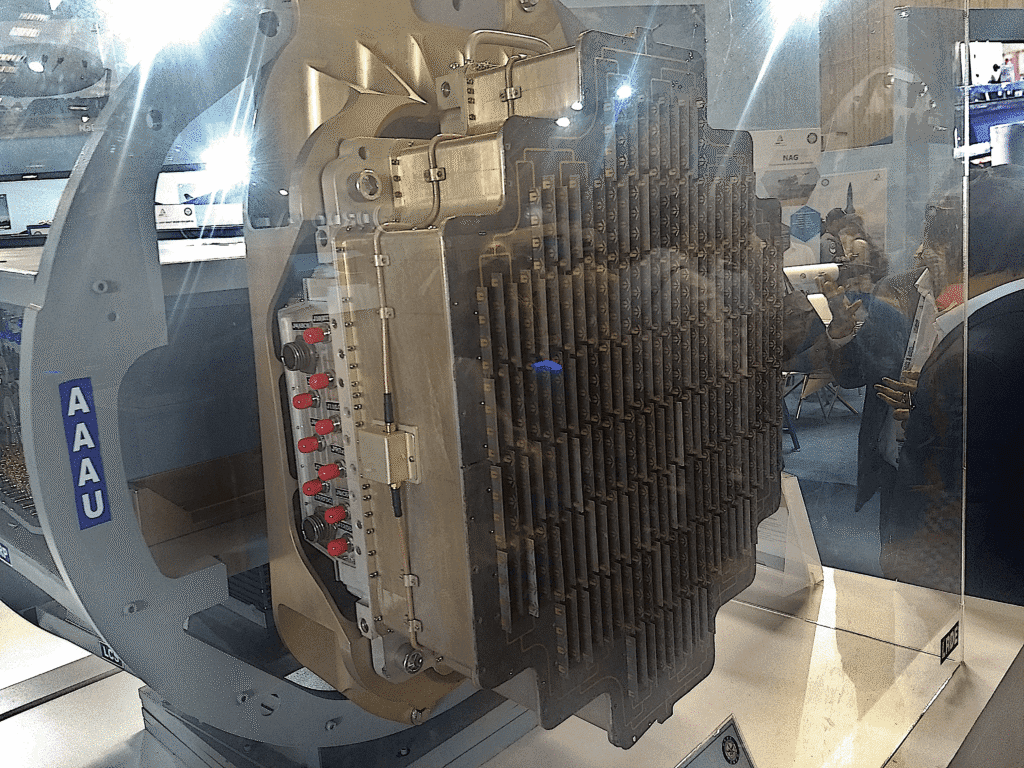

For years the Uttam radar lived in that awkward space between a promising prototype and a real weapon. This week it crossed over. Hindustan Aeronautics Limited has placed a 2,205 crore rupee order with Astra Microwave Products for the components that sit at the core of the radar. The contract quietly marks the system’s shift from the laboratory to the assembly line.
What the Order Actually Covers
The numbers are specific. Astra Microwave will supply 122 Airborne Active Antenna Units and 121 Interface Frames, delivering them over the next five years. The company disclosed the deal in a filing to the stock exchanges. Investors noticed at once. Its shares jumped as much as 14 percent to a record high the same day.
The antenna unit is not a minor part. It is the heart of an AESA radar, the dense array of transmit and receive modules that steer the radar beam electronically. No moving dish sits behind the nose cone. Get that unit right and the radar tracks more targets, at longer range, resisting jamming far better than the older mechanical sets it replaces. Get it wrong and nothing else matters.
Why the Uttam Programme Matters
DRDO’s radar laboratory in Bengaluru developed the Uttam, an indigenous fire-control radar. Its designers built it to give Indian fighters a modern sensor without importing one. Its first home is the Tejas Mk1A. Reporting suggests this order will equip the final batch of 97 of those jets, the ones that would otherwise have flown with a foreign radar.
That last point carries the real weight. Every Tejas that carries an Uttam radar depends a little less on an overseas supplier for its single most vital sensor. The same indigenous logic runs through India’s other airborne programmes. It stretches from the Netra early warning aircraft to the stealth fighter still on the drawing board. Owning the radar means owning the upgrades, the source code and the supply, none of which a vendor can switch off in a crisis.
The Private Industry Angle
A second story runs through this contract too. It is about who builds India’s defence electronics now.
Astra Microwave is not a public-sector giant. It is a private Hyderabad firm that has spent years supplying microwave and radar subsystems to Indian defence programmes. This is among the largest orders it has ever won. HAL designs and assembles the aircraft, DRDO designs the radar and a private company manufactures its beating heart at scale. That division of labour, unthinkable a decade ago, is exactly what a mature defence-industrial base looks like.
One order does not build an ecosystem. But when HAL hands a private firm a 2,205 crore rupee production contract for a frontline fighter’s sensor, it signals clearly where India’s defence manufacturing is heading. The Uttam has left the laboratory. Now the harder work of building it, unit by unit, begins.
Image Credits:
Featured image: Sngineer, CC BY-SA 4.0, via Wikimedia Commons