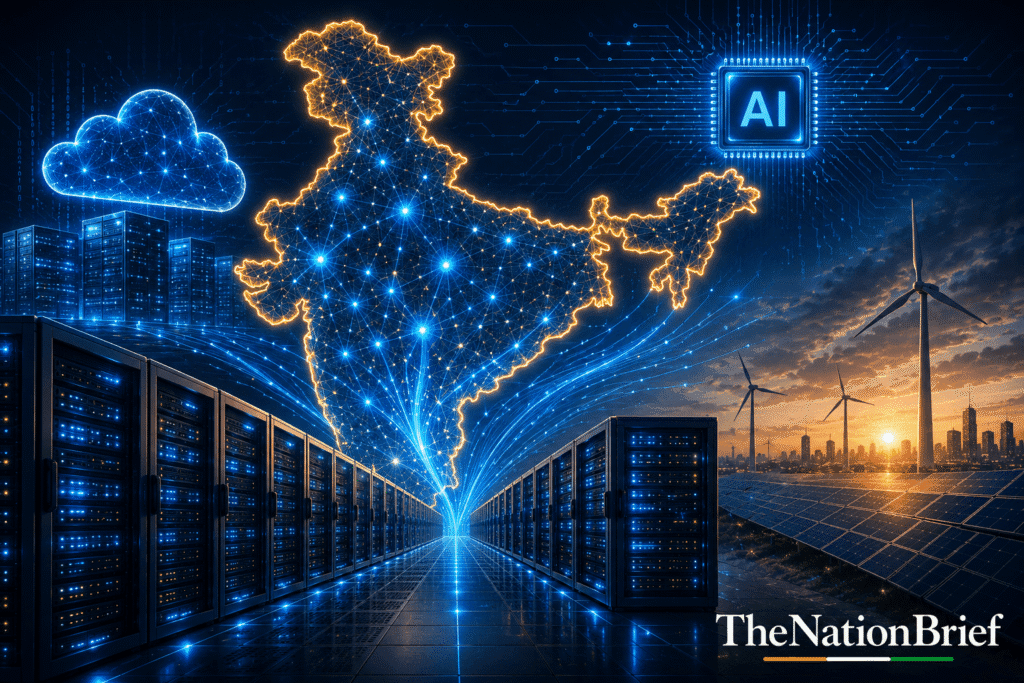

An Indian doctor pulls up a patient’s scan on a hospital server. A farmer checks tomorrow’s weather on a government app. A Bengaluru startup trains a language model in Hindi. Each time, the work happens somewhere. Increasingly, that somewhere is India itself. The country’s data centre industry, once a modest back-office affair, has turned into one of the largest infrastructure buildouts the country has ever attempted and the case for it goes well beyond corporate balance sheets.
A Boom by Any Measure
The numbers alone tell an unusual story. India’s installed data centre capacity crossed 1,700 megawatts in 2025, after a record 440 megawatts added in a single year, a jump of 160 percent over 2024. Industry tracker CBRE expects capacity to grow by roughly 30 percent again in 2026, adding another 500 megawatts. Investment commitments have kept pace. Cumulative pledges to the sector passed 126 billion dollars by the end of 2025 and CBRE projects that figure could cross 180 billion dollars in 2026 alone, a sum larger than the annual economic output of many countries.
The scale becomes easier to picture with a single comparison. Every megawatt of data centre capacity supports around a thousand server racks. The 500 megawatts due in 2026 works out to roughly half a million new server racks. All of it lands on Indian soil in a single year.
Big names are placing the bets. Google is building a 15 billion dollar AI hub in Visakhapatnam with local partners AdaniConneX and Airtel. It is the company’s largest data centre commitment in Asia. Adani has pledged 100 billion dollars by 2035 to build renewable-powered AI data centres. The plan aims to grow its own capacity from 2 to 5 gigawatts. Microsoft has committed 17.5 billion dollars through 2029 to expand cloud and AI infrastructure across the country. Reliance and Brookfield are putting in more than 10 billion dollars of their own. Tata Consultancy Services has drawn a billion dollars from TPG for the same reason, AI-ready capacity. This is not speculative money. Some of the largest technology companies on Earth are choosing to build in India and at a scale the country has never seen before.
Why a Country Needs to Own Its Servers
None of this matters much if it stays an abstraction, so it helps to ask a simple question. Why does any of this benefit an ordinary Indian, rather than just the balance sheets of a handful of conglomerates?
Start with the most basic reason: distance. A server sitting outside Bengaluru serves an Indian user faster than one sitting outside Virginia. Data still travels at the speed of light and undersea cables add distance the physics cannot forgive. Faster servers mean faster banking apps and faster video calls. They also mean faster access to the government portals that a billion people now use for everything from tax filing to ration cards. Infrastructure that used to be invisible has become as essential as electricity or roads. A country of India’s size cannot afford to keep it permanently offshore.
Then there is the question of who holds the keys. Financial records, medical histories, government IDs, all of it increasingly lives on a server somewhere and the country where that server physically sits has a say in what happens to it. Data stored abroad falls under the laws of that country first. That can complicate everything from a police investigation to a company’s ability to operate during a diplomatic dispute. Building capacity at home is not paranoia. It is the same logic behind wanting one’s own power plants and refineries. Compute is simply the newest item on that list.
The AI Angle Changes Everything
If the data centre story of the last decade was about email and e-commerce, this decade’s story is about artificial intelligence. That has raised the stakes considerably.
Training and running large AI models is punishingly compute-intensive and the chips that do this work, GPUs from Nvidia and AMD among others, are caught in the same global chip war that has made semiconductors a matter of state.. The government’s IndiaAI Mission has moved to secure this pipeline. It backs GPU capacity for domestic researchers and startups, so Indian AI development does not have to queue behind better-funded labs abroad. Novacore Innovations has launched India’s first cloud built on Nvidia’s latest Blackwell chips for exactly this purpose. Adani has gone further still. It has set aside part of its own GPU capacity specifically for Indian AI startups and research institutions, a deliberate bet on what industry leaders call data sovereignty.
This matters because AI is fast becoming infrastructure in its own right, the way electricity or telecom once was. A country that can only rent AI compute from abroad will always be a customer of someone else’s technology. A country that builds the capacity at home has a shot at being a maker of it. It can train models in Indian languages, on Indian data, for Indian problems that global labs have little reason to prioritize.
That same logic is what drives India’s parallel push to build the chips themselves, not just the data centres that run on them, through the India Semiconductor Mission.
Jobs, States and a New Kind of Factory Town
The buildout is also reshaping India’s economic map in ways a purely financial reading misses.
Mumbai still leads with around half of India’s data centre capacity, thanks to its subsea cable landings and financial-sector demand, with Chennai a strong second for the same reasons. But the newer, larger projects are pushing into places that have never hosted this kind of investment before. Visakhapatnam, a mid-sized port city in Andhra Pradesh, is emerging as a genuine hub thanks to the Google and Adani projects alone. Telangana, Maharashtra, Tamil Nadu and Uttar Pradesh are all drawing serious capital. Developers are increasingly looking at tier-two cities too, as the metros fill up.
Each large campus becomes something like a modern factory town. It brings construction jobs during the build, skilled technical roles once it is running and a magnet for the power, fibre and cooling infrastructure that follows major digital investment. Reports project the sector could unlock over 100 billion dollars in additional investment by 2032, if India reaches the higher end of its capacity targets. Tens of thousands of high-skill jobs would follow, spreading AI-era growth beyond the handful of cities that usually capture India’s tech gains.
The Honest Challenges Ahead
None of this is without friction and a fair account has to say so.
Power is the first constraint. Data centres, especially AI-focused ones, are extraordinarily energy-hungry. India’s ability to hit its capacity targets depends on how fast it can bring new generation, much of it meant to be renewable, onto the grid. Water is the second constraint. Many facilities still rely on water-based cooling, a real concern where water stress is already acute. The industry’s shift toward liquid cooling, which uses less water than older methods, is a response to that pressure rather than a solved problem. Land, grid connections and skilled technical labour will all need to scale alongside the headline investment figures. Execution, not ambition, will determine whether India reaches the 8 to 9 gigawatts some forecasts describe by 2032.
Why the Bet Is Worth Making
Strip away the billion-dollar press releases and what remains is a straightforward case. Every country that wants a say in the AI era needs somewhere to put the machines that run it. It needs the power, the policy and the talent to keep them running too. India spent decades sending its engineers abroad to build other countries’ technology infrastructure. The current wave of investment, home-grown and foreign capital both, is a chance to build that infrastructure at home instead. It sits closer to the billion-plus people who will use it and closer to the government that answers to them.
The scale of money now arriving, from Google’s campuses in Andhra Pradesh to Adani’s renewable-powered AI parks, will not by itself guarantee India’s place in the AI economy. Money alone never does. But it gives the country something it did not clearly have a decade ago: the physical foundation on which that place can be built. The next few years will be spent laying cable, pouring concrete and connecting turbines to server racks. How much of that promise India actually collects depends on what gets built.