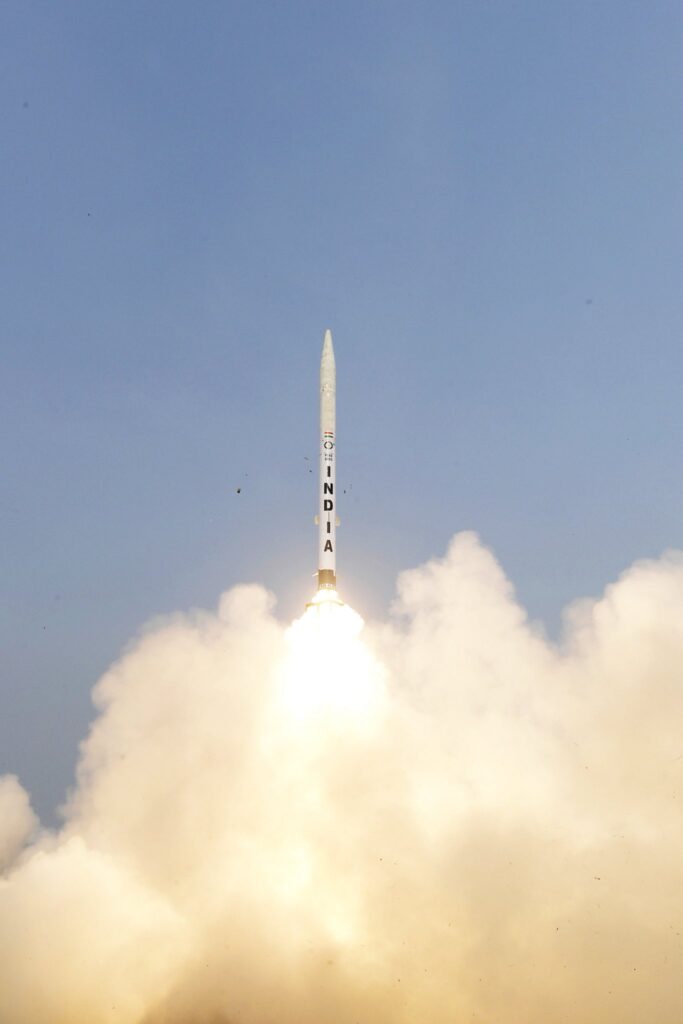

India has crossed a threshold only a handful of states have reached. Over two days in June, the Defence Research and Development Organisation (DRDO) flight tested its multi-layered Ballistic Missile Defence (BMD) system off the Odisha coast. For the first time, the interceptors engaged and destroyed targets in the intercontinental ballistic missile (ICBM) class. That is the clearest sign yet that India’s long effort to build a homegrown missile shield has matured from concept into proven capability. On that basis, the Ministry of Defence said the result puts India in an elite group whose missile defence reaches intercontinental ranges.
A two-tier missile defence, up to ICBM class
The trials took place on 10 and 11 June 2026 at the Integrated Test Range, Chandipur. What sets this round apart, though, is the altitude band it now covers. Of course, India’s shield has long rested on the layered logic that defines every credible BMD network: catch a warhead high, outside the atmosphere, and if that first shot fails, catch it again as it re-enters. Notably, the June tests exercised both tiers. One interceptor engaged in the exo-atmospheric outer layer, while the other worked the endo-atmospheric terminal phase. According to defence reporting, the two interceptors were the AD-1 and AD-2, with the AD-2 forming the outer ICBM-class layer. Those reports also say the targets were Agni-series missiles standing in for a hostile launch. Still, the Ministry of Defence did not name the interceptors in its statement.
Why Ballistic Missile Defence Is Harder
The distinction between this system and conventional air defence is not a technicality. Networks built to stop aircraft, drones, and cruise missiles work in a relatively forgiving envelope. Ballistic missile defence does not. An interceptor has only seconds to detect, track, and destroy a warhead arriving at several kilometres per second, often from the edge of space. Meeting that challenge takes three things at once. It needs long-range radars that spot a target early. It needs command-and-control systems quick enough to compute a firing solution on the fly. And it needs interceptors agile enough to close the gap. The June trials put that whole chain through its paces at once, because the sensors, the communications links, and the interceptors all sat at separate sites.
Update, July 2026: That division of labour became clearer this month. DRDO flight tested the Kusha long-range surface-to-air missile for the first time on 23 July, a system built to kill aircraft and cruise missiles out to 400 kilometres. The BMD interceptors handle what falls from the edge of space. The two programmes cover different physics and run in parallel.
The strategic stakes and an elite club
The strategic logic runs deeper than the hardware. India sits in a neighbourhood where missile arsenals keep growing in number, range, and sophistication. The newest long-range systems increasingly carry multiple, independently targeted warheads. So an ICBM-class intercept speaks directly to that trend. A working shield will not stop every missile in a mass salvo. But it complicates an adversary’s calculations. And in the opening hours of a crisis, when the first strikes are most likely to land, it gives commanders a real chance to protect airbases, command nodes, and strategic assets.
Defence Minister Rajnath Singh congratulated DRDO on the demonstration, calling it a boost to national security preparedness and technological self-reliance. DRDO chief Rajesh Kumar Singh, who monitored the trials, praised the scientists, engineers, and industry partners who ran several complex tests inside a single 24-hour window. That alone is a logistical feat. So far, only the United States, Russia, Israel, and China have shown they can intercept threats at intercontinental ranges, and India now joins that short list.
Two decades of building India’s missile defence
The capability did not appear overnight. It builds on Phase-I, which paired the exo-atmospheric PAD/PDV and endo-atmospheric AAD interceptors, and on a July 2024 Phase-II test that demonstrated defence against threats of the 5,000 km class. Each step has narrowed the gap between a programme that works on the range and a shield that can be relied on in a crisis.
Part of Mission Sudarshan Chakra
The June tests also feed a larger ambition. Speaking in Hyderabad on 12 June, the day after the trials concluded, Rajnath Singh tied India’s missile defence drive to Mission Sudarshan Chakra. Prime Minister Narendra Modi announced that multi-layered shield in his 2025 Independence Day address. As the government describes it, Sudarshan Chakra would spread three layers of protection over not only military installations but critical and civilian infrastructure, and it would give India the means to hit back when needed.
Singh built his case around two ideas he called central to national security. Resilience, he said, is the capacity to absorb a shock and recover. Deterrence is the power to make an aggressor think twice. He pointed to indigenous systems such as Akash and BrahMos, which performed well during Operation Sindoor, as proof that India’s defence-research base can deliver at scale. Seen against that backdrop, the ICBM-class intercept reads less as a one-off feat and more as an early brick in a wall New Delhi means to keep building.
A calculated bet on deterrence
As regional arsenals keep evolving, the June tests point to more than engineering progress. They reflect a deliberate calculation in New Delhi. A working missile defence strengthens deterrence rather than weakening it, because the power to blunt a long-range strike makes such an attack less likely. For India, then, the programme is at once a security measure and a statement of technological intent. Its trajectory will draw close attention across the region.
Sources: Ministry of Defence / Press Information Bureau, “DRDO demonstrates the nation’s next-gen defence capabilities,” 13 June 2026 (PRID 2272374), for the flight tests.
“Raksha Mantri inaugurates an Advanced Weapon System Complex at DRDL, Hyderabad,” 12 June 2026 (PRID 2272327), for the Mission Sudarshan Chakra and Operation Sindoor remarks.
Interceptor designations (AD-1, AD-2), the Agni-series target detail and the Chandipur launch site are drawn from defence reporting and were not specified in the official release.