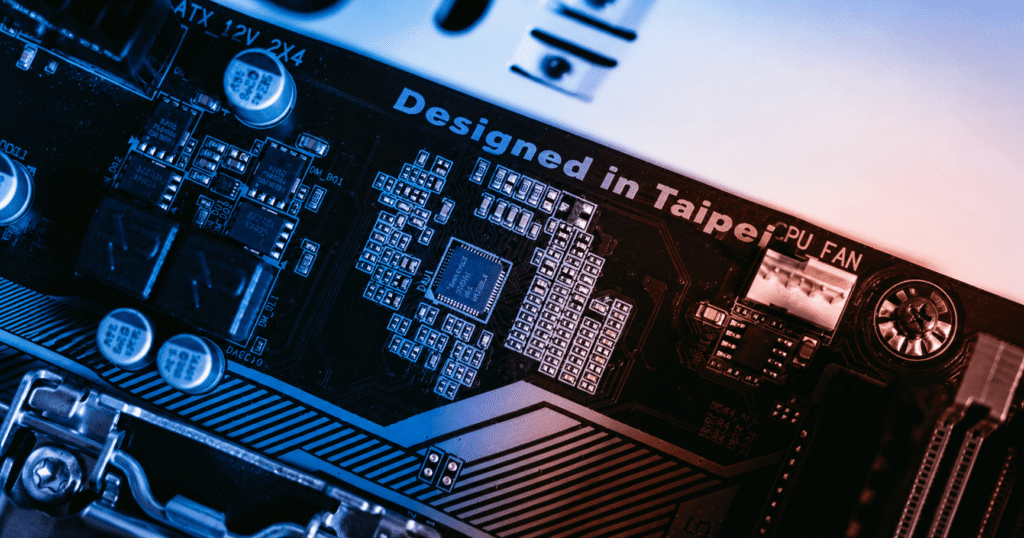

There is a building on the west coast of Taiwan, in a city most of the world cannot place on a map, that the global economy cannot function without.
Inside it, in rooms cleaner than an operating theatre, machines etch patterns onto silicon wafers at a scale measured in billionths of a metre. The features are so small that hundreds would fit across the width of a human hair. The chips that come out of this place, and a handful of others like it, sit at the heart of nearly everything that matters in the twenty-first century. The phone in your pocket. The fighter jet patrolling a contested border. The missile that guides itself. The car that brakes before you do. The data centre training the AI models that companies now bet their futures on.
Take those chips away and none of it works. Not “works worse” but works at all.
That is the uncomfortable truth at the centre of what people have started calling the Chip War. A single category of product, made in a vanishingly small number of places, has quietly become the resource that great powers will bend trade rules, rewrite alliances and risk confrontation to control. Oil built the geopolitics of the twentieth century. Semiconductors are building the geopolitics of the twenty-first. Unlike oil, you cannot simply find more of it somewhere else.
Why a Chip Is Not a Barrel of Oil
It is tempting to reach for the oil comparison, because for a hundred years energy was the strategic commodity, the thing nations fought wars over, propped up dictators for and built navies to protect. But the comparison breaks down exactly where it gets interesting.
Oil is everywhere. It sits under Texas and Siberia and the North Sea and the deserts of the Gulf. When one source gets cut off, buyers grumble, prices spike and the market reroutes. Oil is also fungible. A barrel is a barrel and one supplier’s crude can substitute for another’s with a bit of refining. The leverage any single producer holds is real but bounded.
What Makes a Chip Different
Advanced semiconductors are the opposite on every count.
They are not everywhere. The most sophisticated logic chips, the ones that power AI, advanced weapons and high-end computing, roll off production lines in essentially one place on Earth. They are not fungible. You cannot take a chip designed for one purpose and slot it into another and you certainly cannot conjure a cutting-edge fabrication plant out of nothing when supply tightens. A leading-edge “fab” costs upwards of twenty billion dollars and takes years to build and even then it only works if a global web of suppliers, for the machines, the chemicals, the design software and the ultra-pure materials, all keep flowing.
This is the heart of it. A semiconductor is the most complex object humans manufacture in volume and the ability to make the best ones rests in fewer hands than the ability to build nuclear weapons. That concentration is what turns a manufactured good into a strategic chokehold. Whoever controls the chip supply chain controls the pace of everyone else’s progress in artificial intelligence, in defence, in the entire digital economy.
So the question stops being commercial and becomes national. Once that happens, governments stop behaving like customers and start behaving like combatants.
The Chokepoints Almost Nobody Sees
Here is the part that surprises people when they first learn it: the most powerful companies in the chip war are not the ones whose names you know.
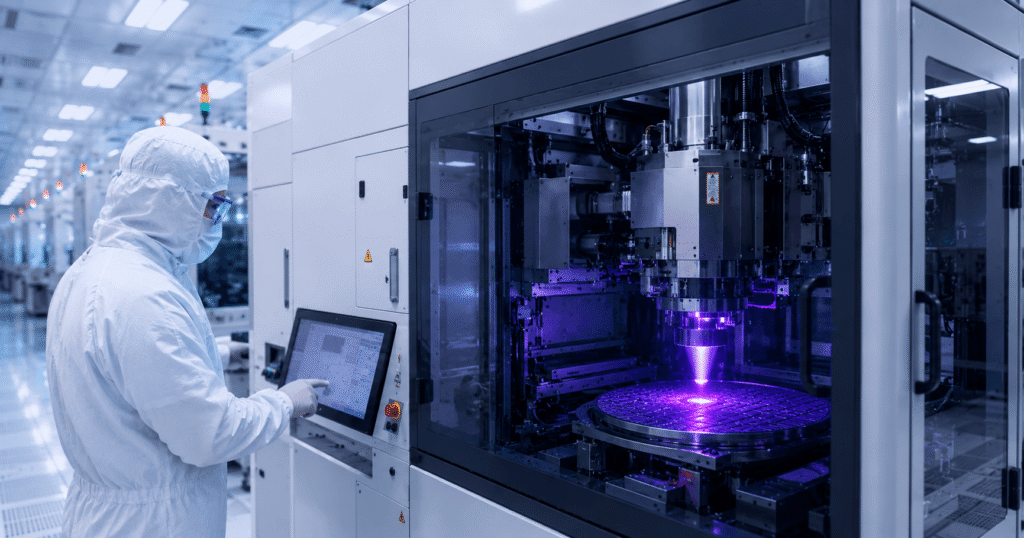
Everyone has heard of Nvidia. It designs the chips that the AI boom runs on and its valuation has made headlines for years. But Nvidia does not actually make anything. It draws the blueprints and hands them to someone else. That someone else, overwhelmingly, is the Taiwan Semiconductor Manufacturing Company, TSMC, the company in that building on Taiwan’s coast.
TSMC is what the industry calls a foundry: it manufactures chips that other companies design. At the leading edge, the most advanced nodes, where the transistors are smallest and the performance highest, it is essentially the only game in town. Its two natural competitors, Intel and Samsung, have both stumbled badly on yield, the brutal industry measure of how many usable chips you get from each wafer. With both of them struggling, TSMC has become the only company that can manufacture the most advanced chips reliably and at scale. That dominance runs so deep that the company can reportedly raise prices on its leading-edge work and still face customers lining up, Nvidia among them, with TSMC projecting that demand for AI chips like high-end GPUs could grow at roughly forty percent a year for the next several years.
ASML: The Monopoly Behind the Monopoly
But TSMC, for all its power, depends on someone further up the chain. To etch those impossibly fine patterns, it needs a particular kind of machine, an extreme ultraviolet (EUV) lithography system. There is exactly one company on the planet that makes them.
That company is ASML, based in the Netherlands. Not a household name. Not a tech-press darling. Yet if TSMC is a near-monopoly, ASML is the real thing, a genuine, full-blown monopoly with no competitive alternative whatsoever. If you want to make a cutting-edge chip, you need an EUV machine and if you want one, you buy it from ASML or you do not make the chip. Full stop. These machines rank among the most complex devices ever engineered, assembled from components sourced worldwide and they do not come cheap. ASML’s next-generation High-NA EUV systems, which shrink chip features even further, reportedly run around four hundred million dollars each, roughly double the price of the previous generation, which itself cost more than a commercial airliner.
A Supply Chain No One Controls Alone
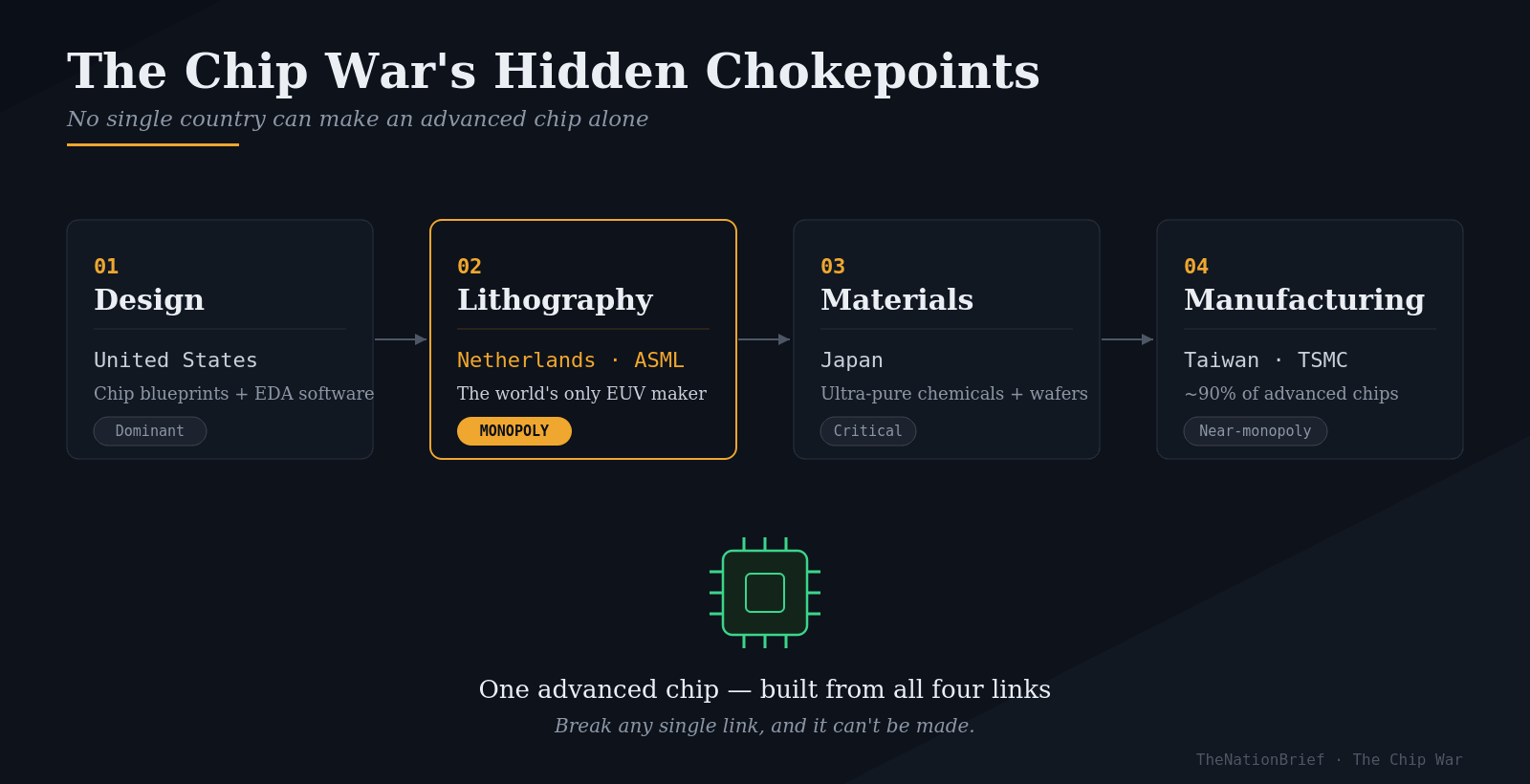
Step back and the picture looks almost absurd. The most strategic industry on Earth runs through a handful of irreplaceable nodes: design tools and intellectual property concentrated in the United States, the lithography monopoly in the Netherlands, key materials and chemicals in Japan and the manufacturing itself in Taiwan and South Korea. No single country, not even the United States, not even China, can build a leading-edge chip entirely on its own. The supply chain is a relay race in which every runner is essential and several of them exist in only one country.
That fragility is not a bug the industry is rushing to fix. It is the entire reason the chip war exists. Each one of those chokepoints is a place where a determined government can apply leverage. Over the past few years, the major powers have done exactly that.
The Front Line: Washington versus Beijing
The opening shot, as most people date it, came in October 2022. The United States rolled out sweeping export controls aimed squarely at China’s ability to build and buy advanced computing and chipmaking technology. The logic, as Washington later explained it, was a doctrine its strategists nicknamed “small yard, high fence”: don’t try to block everything, but build a very high wall around the narrow set of technologies that matter most for military and AI power.
What followed was not a single policy but an escalating series of them. Washington tightened the 2022 rules in October 2023, tightened them again in December 2024 and, crucially, extended them outward by leaning on allies like the Netherlands and Japan to impose parallel restrictions, so that the chokepoints they controlled would close too. The Center for Strategic and International Studies has framed the stakes plainly: the outcome of this chip race will help determine which country leads in artificial intelligence, with profound consequences for both economic and national security.
How 2026 Rewrote the Rules
Then 2026 made everything more complicated.
In January, the rules pivoted in a direction that confused even the experts. The Bureau of Industry and Security shifted its review policy for certain advanced AI chips bound for China from a near-automatic presumption of denial, effectively a ban, to a case-by-case licensing system with strict conditions, while the White House simultaneously slapped a twenty-five percent tariff on a narrow band of semiconductors under a national-security trade provision. Ban it, then partially unban it, then tax it. Industry analysts openly called the resulting framework contradictory. By June 2026, the Commerce Department was issuing fresh guidance to plug the loopholes, clarifying that the restrictions reached even subsidiaries of Chinese firms operating outside China, after it became clear that chips kept finding their way around the fence.
There, in that last detail, sits the central problem with the entire strategy: chokepoints leak.
China’s Workaround
China has not sat still. Cut off from the best machines, it poured state resources into building its own. Its national champion foundry, SMIC, managed to produce surprisingly advanced chips using older deep-ultraviolet machines it had stockpiled before the controls bit, squeezing extra precision out of them through painstaking multi-patterning techniques. The results carry real penalties: higher costs, lower yields, slower progress. But they exist, which is the point. In early 2026, reporting indicated that another Chinese player, Hua Hong, was preparing its own advanced-node production, a sign that the capability is spreading inside China rather than staying bottled up.
The deeper consequence is something analysts have started calling bifurcation. Rather than one global chip ecosystem, the world is drifting toward two, a Western stack and a Chinese stack, with increasingly separate supply chains, chip architectures and AI infrastructure that may not even work with one another. Washington designed the export controls to slow China down. They have done that, at the high end. But they have also handed Beijing the strongest possible incentive to build a parallel universe of technology that Washington cannot reach into at all. Whether that counts as success depends entirely on how you keep score.
The Island in the Middle
You cannot talk about chips for long without arriving at Taiwan, because Taiwan is where the abstract becomes terrifyingly concrete.
The same concentration that makes TSMC commercially dominant makes its location a geopolitical fault line. A staggering share of the world’s most advanced chips comes off production lines on an island that China claims as its own territory and has never ruled out taking by force. Every government that depends on those chips, which is to say every advanced economy on Earth, has a direct, vital stake in what happens in the Taiwan Strait. That is not a hypothetical concern. It is a permanent feature of the strategic landscape.
The Silicon Shield Theory
This has given rise to a theory often called the “silicon shield.” The argument goes that Taiwan’s irreplaceable role in chipmaking is itself a form of protection: China would not dare disrupt the island militarily, because doing so would shatter a supply chain that China’s own economy also leans on and would invite catastrophic intervention from the rest of the world. The chips, in this telling, are the island’s insurance policy.
Critics find the shield comforting but shaky. A shield that depends on your adversary’s economic rationality is only as strong as that rationality holds. The shield logic cuts the other way too: precisely because the concentration is so dangerous, every other power now wants to reduce its dependence on Taiwan, which, taken to its conclusion, would erode the very shield that keeps the island safe. The world’s attempt to make itself less vulnerable could, paradoxically, make Taiwan more so.
What is not in dispute is the scale of the disruption a conflict would cause. Estimates of the global economic damage from a serious interruption to Taiwan’s chip output run into the trillions of dollars, a shock that would dwarf any oil crisis in history, freezing production lines for cars, electronics, weapons and computers across every continent at once. It is the single largest concentration of economic risk on the planet, sitting on a geological and political fault line.
Everyone Scrambles, Including India
Faced with all this, the response of the world’s major economies has been remarkably uniform: stop depending on someone else’s factories. Bring chipmaking home.
The United States passed its CHIPS Act, pouring tens of billions in subsidies into domestic fabs and luring TSMC, Intel and Micron into building on American soil. The European Union launched its own Chips Act with similar ambitions. Japan, once a semiconductor superpower that had faded, moved aggressively to revive its industry and pull leading-edge manufacturing back to its shores. The logic everywhere is the same: in a world where chips are strategic, depending on a distant and possibly contested supply is a vulnerability no serious power will accept.
By late 2025 this scramble had hardened into a formal US-led pact, Pax Silica, that sorts the world by who controls the chips.
Update, July 2026: Bilateral deals are reinforcing the same push. India and Japan used their 16th Annual Summit to commit to a joint roadmap on semiconductor supply chains, another thread in the wider race to reduce dependence on any single source.
Update, July 2026: India has extended this playbook to raw materials too. A new Critical Minerals Corridor with Australia targets the lithium and rare earth inputs that sit upstream of the entire chip supply chain.
Update, July 2026: The same scramble is reshaping India’s AI infrastructure. The country’s data centre boom depends on the same GPUs caught up in this global contest.
India’s Big Bet
Then there is India, which, for readers of this publication, is where the story turns personal.
For decades, India watched the semiconductor revolution happen elsewhere, contributing brilliant chip designers to the world’s biggest firms while manufacturing virtually nothing at home. That is now changing, faster than most sceptics predicted. The vehicle is the India Semiconductor Mission (ISM), launched in December 2021 and now in its second, more ambitious phase. ISM 2.0, given a major push in the 2026 budget, widens the focus beyond fabs to the harder, deeper layers of the ecosystem: equipment, materials, design intellectual property and research.
We break this down in detail in our guide to the India Semiconductor Mission.
The numbers have started to add up to something serious. By mid-2026, the government had approved more than a dozen semiconductor projects across several states, with cumulative investments reaching roughly ₹1.64 lakh crore. The scheme offers fiscal support of up to half a project’s cost, an extraordinary level of state backing that signals just how strategically New Delhi now views this industry.
India’s Milestones So Far
The milestones have become tangible rather than promised. In February 2026, Prime Minister Modi inaugurated Micron’s assembly, test and packaging facility at Sanand in Gujarat, the first operational facility of the current cycle. Weeks later, in March, Kaynes Semicon’s packaging plant at the same Gujarat hub came online. The centrepiece of the whole effort is the Tata Electronics fab at Dholera, built with Taiwan’s Powerchip (PSMC), India’s first true wafer-fabrication plant, with first silicon targeted for late 2026 and the fab expected to scale toward full operation around 2028. Up in Assam, Tata’s massive assembly and test facility at Jagiroad is bringing the industry to the Northeast for the first time, an unusual and deliberate geographic stretch. Union Minister Ashwini Vaishnaw has laid out a clear roadmap: several plants operational by the end of 2026, more in 2027 and the country’s first full fabrication unit maturing at Dholera by 2028.
The Hurdles India Still Faces
It would be dishonest to pretend the road is smooth. Most of what India is building today sits at the back end of the chain, assembly, testing and packaging, which is genuinely valuable but is not the same as making leading-edge logic chips. The Dholera fab, when it matures, will not operate at the bleeding edge that TSMC occupies. It will make the mature-node chips that run cars, appliances and industrial equipment, a smart, achievable place to start but a starting point nonetheless. India still imports nearly all its chipmaking equipment and chemicals, still needs to grow a manufacturing workforce almost from scratch and still has to prove it can run fabs at the punishing yields the economics demand.
But strategy is about direction, not just position. A few years ago, India made nothing. Today it has a credible, well-funded, multi-state semiconductor base under construction, anchored by serious industrial players and foreign technology partners, with the explicit national goal of self-reliance in the most strategic industry of the age. For a country that sits in a tense neighbourhood and imports the silicon brains of its entire defence and digital economy, that is not a vanity project. It is strategic insurance.
The Accelerant: Artificial Intelligence
If all of this was already true a few years ago, one force has poured petrol on the fire: artificial intelligence.
The AI boom is, at its physical core, a chip boom. Training and running large AI models demands enormous quantities of the most advanced semiconductors in existence, the very chips concentrated in the most fragile parts of the supply chain. The data-centre buildout now under way is the largest surge in demand for cutting-edge silicon the industry has ever seen, with no sign of slowing. This is why TSMC can raise prices and still sell everything it makes and why ASML’s order books stretch years into the future.
It also raises the stakes of the whole contest. If AI is going to be the defining technology of the coming decades, shaping economies, militaries and the balance of power between nations, then control over the chips that AI runs on is control over AI itself. The export controls on advanced chips are, in the end, controls on a rival’s ability to build artificial intelligence. The chip war and the AI race have become the same war, fought with the same weapons.
That is the logic now driving governments to spend hundreds of billions, rewire trade relationships and accept economic friction they would never have tolerated over an ordinary commodity. They have understood something fundamental: in a world where intelligence itself can be manufactured, the factories that make the chips are the most strategic ground there is.
The Resource of the Century
Come back, finally, to that building on the coast of Taiwan.
It is just a factory: concrete and steel and impossibly clean air. But it represents something the world is only beginning to reckon with fully, that the most precious strategic resource of our era is not pumped from the ground or dug from a mine, but printed onto silicon by a handful of companies in a handful of places, through a process so difficult that no nation has yet mastered all of it alone.
That is what makes semiconductors different from every resource that came before. You could always find oil in new fields. Empires could draw on new colonies. But you cannot discover a new TSMC and you cannot stockpile your way out of needing the next generation of chips. You can only build the capability, slowly, expensively, over years, or remain dependent on those who have it.
This is why the chip war will define the coming decades the way the contest over oil defined the last century. It is a war fought not with armies, for now, but with export controls, subsidies, alliances and the patient, ferociously expensive work of building factories. The countries that understand this, and India, belatedly but decisively, now counts among them, are racing to secure their place in a supply chain on which everything else depends.
The stakes could not be higher and the resource could not be smaller. A few atoms of silicon, arranged just so, have become the thing the world’s great powers are least willing to do without and the thing they are most determined never again to let someone else control.