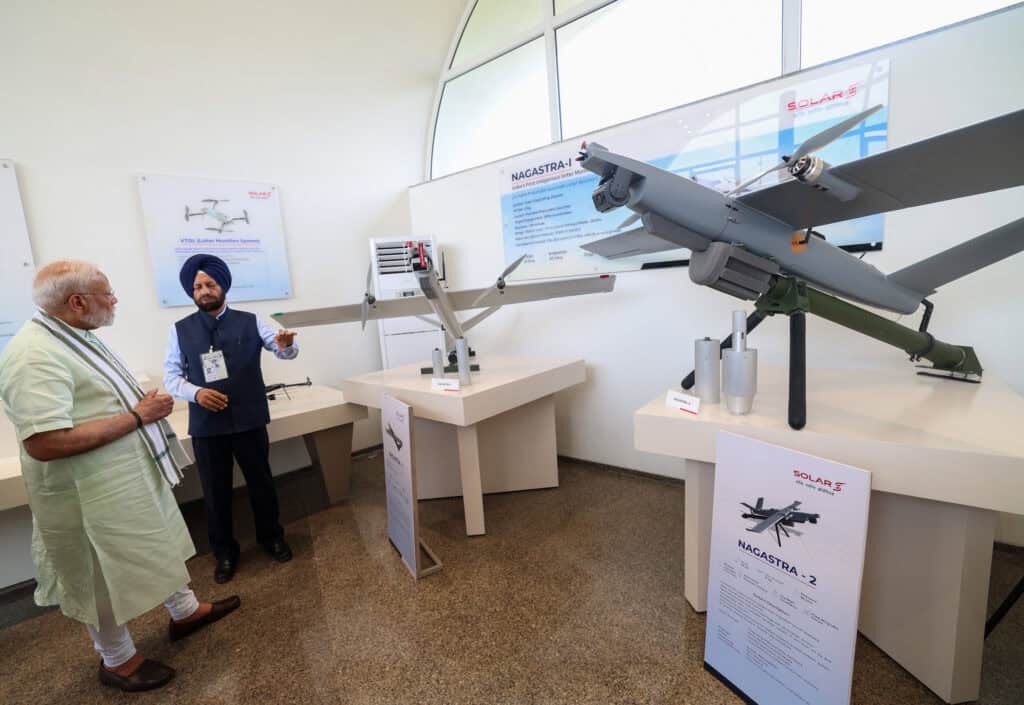

The Indian Army has begun a process to acquire indigenous long-range loitering munitions with a 1,000 km strike envelope, GPS-denied navigation and AI-enabled targeting, The Economic Times reports.
The Indian Army wants a new class of homegrown strike drones. It wants them to fly further than anything currently in its one-way attack fleet. According to a report by The Economic Times, the Army has kicked off the process to acquire indigenous long-range loitering munitions under a project called LRLM, short for Long Range Loiter Munition. The report, by defence correspondent Manu Pubby, says the Army wants systems that can hit targets out to 1,000 km. They must also operate where GPS signals are denied and carry AI-enabled targeting.
The Army has opened the process under the Make II category of India’s acquisition policy. That route asks industry to fund its own research and development. The Army commits to buy the systems only once they clear the required technical trials. It is a familiar path for indigenous projects. It shifts early financial risk onto private developers rather than the exchequer.
The specifications point to a rugged, long-endurance weapon. ET reports that the Army wants a drone able to carry a 25 kg warhead for a 50 metre kill radius. It should fly above 5,000 metres and reach speeds of at least 400 km per hour. The system also needs the ability to evade jamming, a requirement that reflects hard lessons from recent conflicts. Designers must ruggedise the drones to military standards and build them for operations across plains, deserts, jungles and hilly terrain, the report adds.
The Regiment of Artillery has initiated the LRLM process. It is running a parallel effort for shorter-range one-way attack drones at the same time. ET reports that Tata Advanced Systems and Nibe Defence were recently shortlisted for a separate procurement of 850 drones capable of hitting targets beyond 100 km. Taken together, the two efforts suggest the Army is building a layered drone strike capability. It is not settling for a single system, with the LRLM project reserved for the deepest targets.
The requirements also echo strike patterns seen in the Russia-Ukraine war. According to the report, the Army wants its drones to strike on steep, slant and nape-of-earth profiles, similar to systems deployed in that conflict. They must also carry different warhead types, including thermobaric and deep-penetration variants. The Army is separately reviewing how much of each drone’s engine, electro-optic payload, avionics, mainframe, warhead and subcomponents are indigenous or imported. Where parts remain imported, it plans to indigenise them over time.
The scale of ambition extends beyond the aircraft itself. ET reports that the Army wants an entire ecosystem for long-range one-way attack drone operations. That covers a launch vehicle, a ground control station, a simulator and 15 aerial vehicles as part of one system. Exact procurement numbers are yet to be finalised. The report notes India has a broader requirement running into the thousands of one-way attack drones across different ranges.
The push fits a wider pattern across India’s forces. Deep-strike ambitions increasingly rely on cheaper, attritable platforms rather than crewed aircraft alone. A 1,000 km loitering munition would give the Army new reach. It would mark its first indigenous one-way strike system at that range. The Make II route also signals something else. New Delhi still prefers building that reach at home through Indian industry rather than importing it. Success will depend on one thing. It hinges on how quickly Indian developers can clear the tough technical bar the Army has set. The direction of the programme, at least, is now clear.