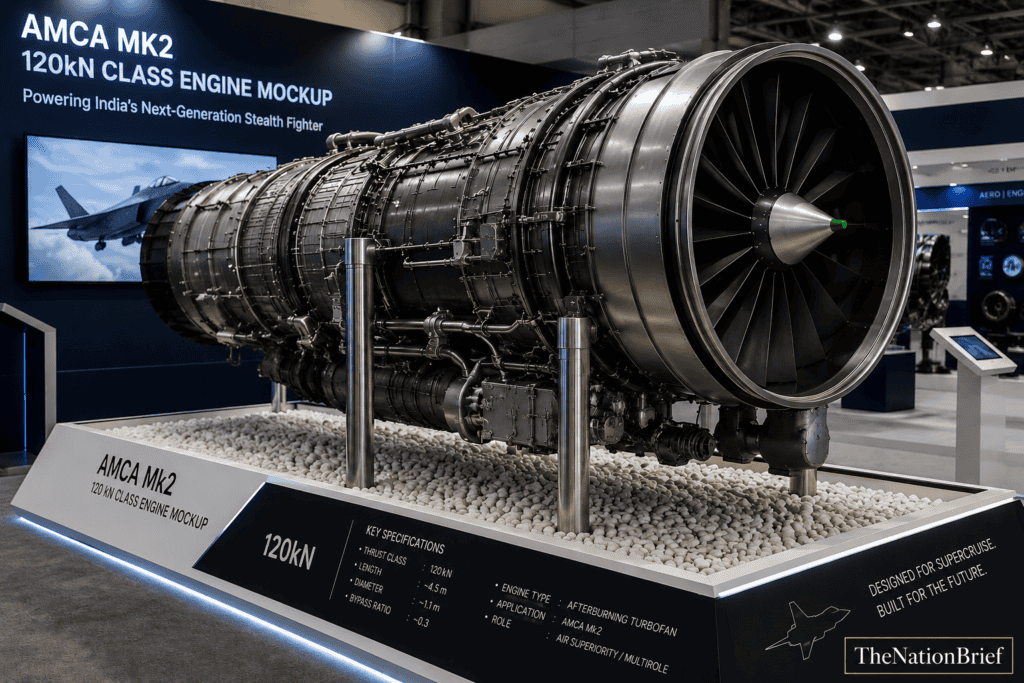

India can design a stealth fighter. Whether it can power one with an engine of its own is the harder question and in 2026 it has become the most consequential one hanging over the entire Advanced Medium Combat Aircraft programme. The airframe, the radar and the weapons are all moving ahead. The engine for the more capable AMCA Mk2 is still up for grabs.
Two of the world’s three serious fighter-engine houses are now fighting for it. Britain’s Rolls-Royce and France’s Safran are locked in a contest to co-develop a 120 kN-class engine with India and both have put unusually generous terms on the table. New Delhi is paying for the programme, so it is demanding what foreign suppliers almost never give: full transfer of technology and ownership of the intellectual property. That single condition has turned a procurement into a strategic crossroads.
The stakes run far beyond one aircraft. A fighter engine is the hardest machine in aerospace to build and only a handful of nations have ever mastered it. If India gets this right, it does not just power the AMCA Mk2. It builds the foundation for a sovereign engine industry that could feed its naval fighters, its sixth-generation ambitions and its export hopes for decades.
This guide breaks down the whole picture as it stands in 2026: what the AMCA Mk2 engine programme is, why India is so determined to own the technology, what the engine has to do and how the Rolls-Royce and Safran bids compare. It also looks at the role of GTRE and the long shadow of the Kaveri, the two-track strategy taking shape behind the scenes and the risks that could still slow the whole thing down.
What the AMCA Mk2 Engine Programme Is
The AMCA is being built in two stages and the engine is what separates them. The first tranche, the AMCA Mk1, will fly on the American GE F414, a proven engine in the roughly 98 kN class. The Mk2 is the more capable variant and it needs more power. India wants a new 120 kN-class engine for it, developed at home rather than bought off a foreign shelf.
The word “developed” is doing a lot of work. India is not looking to licence-build someone else’s engine and bolt it on. It wants to design, build and own the engine, with a foreign partner supplying the know-how India lacks. That means a full transfer of technology and, crucially, Indian ownership of the intellectual property generated under the programme. Because New Delhi is funding the effort, it expects to keep the IP rather than hand it to the manufacturer.
This is the condition that shapes everything. It rules out the kind of arrangement India has accepted before, where a licence allowed local assembly while the core design stayed locked abroad. It also explains why two European giants are now competing so hard. Each is offering deeper technology sharing and more local industrial participation than it would normally consider, because the prize is a partnership that could run for forty years.
Why India Needs Its Own Fighter Engine
India has spent decades importing fighter engines and every import has come with a leash. The GE F414 that will power the Mk1 is being produced in India under an 80 per cent technology-transfer deal, but most analysts see it for what it is: a manufacturing arrangement, not a transfer of design knowledge. India will be able to build the engine. It will not fully understand how to design the next one.
That gap matters more than it sounds. The ability to design a fighter engine from a clean sheet is one of the rarest capabilities in defence, held by only the United States, Britain, France and Russia, with China still working to join them. A nation that cannot design its own engines stays dependent on those that can, for upgrades, for spares and for permission to export. For a country with India’s ambitions, that dependence is a strategic ceiling.
The Kaveri programme taught this lesson the hard way and we will come back to it. The short version is that India tried to build an indigenous fighter engine, fell short of the thrust the Tejas needed and had to keep buying American engines instead. The AMCA Mk2 engine is the second attempt and this time India is structuring the deal to capture the design knowledge it missed before.
There is also a hard operational reason. A fifth-generation stealth fighter asks more of its engine than any previous generation. It needs the thrust to supercruise, the thermal design to hide its heat signature and the reliability to do both for decades. India cannot keep outsourcing the single most important system on its most important aircraft and still call the programme sovereign.
The Engine That Powers AMCA Mk1: GE F414
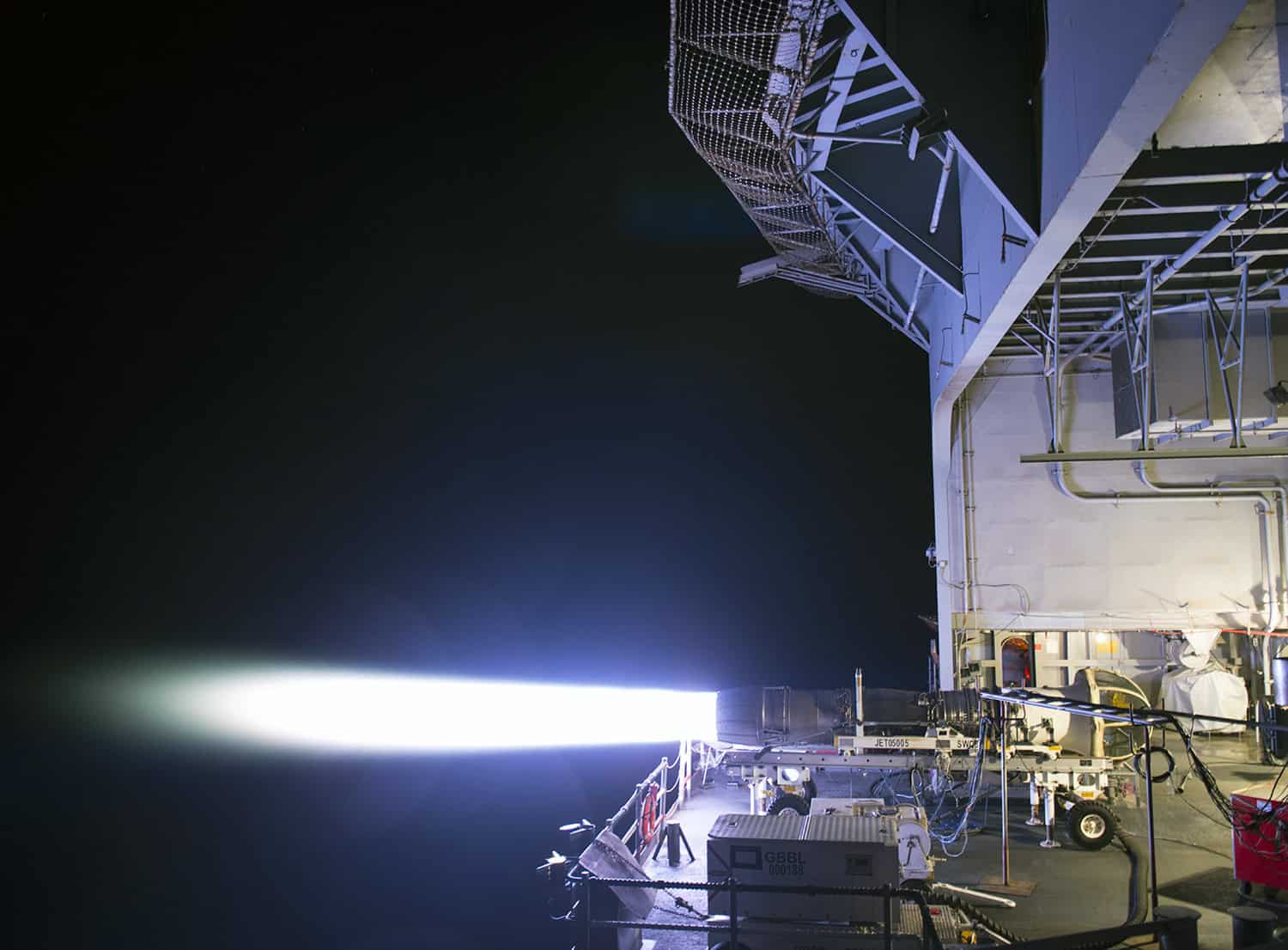
Photo: U.S. Navy, public domain.
The Mk1’s engine choice is the pragmatic part of the story. Rather than wait for an indigenous engine that does not yet exist, India will fly the first AMCA on two GE F414s, the same proven powerplant chosen for the Tejas Mk2. The engine is mature, reliable and well understood, which removes a major risk from the maiden-flight timeline.
GE Aerospace and Hindustan Aeronautics Limited have agreed to produce the F414 in India under a roughly 80 per cent technology-transfer arrangement. That deal builds real manufacturing capacity and it matters. But it is licence production at heart and it does not hand India the design authority it wants for the long run.
The F414 also sets the benchmark the Mk2 engine must beat. At around 98 kN, it gives the Mk1 solid performance, yet it falls short of what a heavier, more demanding Mk2 needs to supercruise with a full internal load. That shortfall is the whole reason for the 120 kN programme. There is a quiet warning attached, too. If the indigenous engine slips, India may have to order more F414s to keep the AMCA flying, deepening exactly the dependence the Mk2 engine is meant to end.
The 120 kN Challenge: What the Engine Must Do
Building a 120 kN engine is not simply a matter of making the F414 bigger. The target sits at the edge of what only a few countries can achieve and several demands pull against each other at once.
Thrust and supercruise
The headline number is thrust and the goal is a 120 kN baseline with room to grow toward 140 kN for heavier future variants. Raw thrust is only half the point. The engine must also let the AMCA supercruise, holding supersonic speed without lighting its afterburners. Supercruise extends range, cuts fuel burn and reduces the heat the aircraft gives off, which feeds straight into stealth.
Heat, stealth and materials
A stealth fighter has to hide from infrared sensors as well as radar, so the engine’s thermal design is part of its survivability. Managing that heat while running hotter for more power is a brutal engineering trade. It depends on hot-section metallurgy that very few nations command, including single-crystal turbine blades able to survive temperatures that would melt ordinary alloys. India’s Defence Metallurgical Research Laboratory has worked on exactly these materials and that domestic base is one reason the programme is credible.
Reliability over decades
The last demand is the least glamorous and the most important. A fighter engine must deliver this performance reliably for thirty years or more, across punishing duty cycles, with predictable maintenance. Reliability is where many engine programmes quietly fail and it is the hardest thing for a first-time developer to get right. It is also why India wants a partner that has done it before.
The Contenders
The field has narrowed to two genuine bidders, with the American incumbent hovering in the background as a fallback. Both European bids share India’s core demand of full technology transfer and Indian IP ownership. They differ in pedigree, philosophy and the future they are selling.
Safran’s offer
France’s Safran leads the field as the widely seen frontrunner. Its pitch centres on co-development with India’s Gas Turbine Research Establishment, offering a scalable engine that starts at 120 kN and stretches toward 140 kN for heavier AMCA variants. Safran has proposed a complete engine assembly line in India, with full technology transfer and GTRE retaining ownership of the intellectual property. Late in 2025 it strengthened the bid by adding adaptive-cycle elements aimed at improving supercruise and keeping the design current with global trends.
Safran brings a proven track record to the table. It builds the M88 that powers the Rafale already in Indian service, so it understands both the technology and the customer. India named Safran its preferred partner in 2025, a move that reflected this lead. But India has not signed any deal, and the bid carries baggage too. India has complained in the past that French technology transfer arrived thinner than promised on programmes like the Scorpene submarine, and that memory colours the negotiation.
Rolls-Royce’s offer
Britain’s Rolls-Royce has mounted an aggressive late challenge and built its bid around two ideas: full ownership and future-proofing. The company has offered a clean-sheet 120 kN-plus engine designed in India, with 100 per cent transfer of technology and all intellectual property generated under the programme staying with India. It has put a firm timeline behind the offer. If India signs by the end of 2026, Rolls-Royce promises a core test by 2030, a first flight by 2034 and production by 2036.
The pitch goes beyond a single engine. Rolls-Royce wants India to become its fourth global propulsion hub after Britain, the United States and Germany, covering design, development, manufacturing, maintenance and future upgrades. Its chief executive has called India a “third home market” and spoken of doubling the company’s local workforce. The technology angle is pointed, too. Rolls-Royce draws on variable-cycle work tied to Britain’s sixth-generation Global Combat Air Programme and stresses that its engine core could power naval fighters once marinised and evolve to meet sixth-generation needs. One senior Rolls-Royce figure took a jab at the competition by noting that only three genuine fighter-engine makers exist in the world.
The GE F414 fallback
Behind the two European bids sits the engine already in the programme. If the indigenous effort slips, India can fall back on more GE F414s, which HAL is set to build at home. It keeps the AMCA flying, but it is a stopgap, not a solution. Leaning on it would mean accepting more licence production and less of the design sovereignty the Mk2 engine should deliver.
Head-to-Head: How the Two Bids Compare
The two European offers look similar on the surface and diverge underneath. Both promise full technology transfer and Indian IP, which is itself remarkable. The real differences lie in pedigree, timeline and the future each is selling.
| Feature | Safran | Rolls-Royce |
|---|---|---|
| Thrust class | 120 kN, scalable to 140 kN | 120 kN-plus, scalable |
| Technology transfer | Full, with GTRE | Full, designed in India |
| IP ownership | India retains it | India retains it |
| Indian partner | GTRE | GTRE and local ecosystem |
| Stated timeline | Core runs around 2032 | Core 2030, flight 2034, production 2036 |
| Track record in India | M88 powers the Rafale | New deep partnership |
| Future-proofing pitch | Adaptive-cycle elements | Variable-cycle, GCAP-linked |
| Naval and 6th-gen path | Scalable family | Marinised and 6th-gen ready |
| Main concern | Past ToT disputes | Unproven India partnership |
Read the table and the choice resolves into a question of philosophy. Safran offers immediacy and a partner India already works with, which lowers risk for a programme that needs an engine in the 2030s. Rolls-Royce offers a longer horizon, pitching not just an engine but a propulsion ecosystem aligned with sixth-generation airpower. One sells a safer path to the Mk2. The other sells a bridge to the aircraft after it.
GTRE and the Kaveri Legacy
Whichever partner wins, the Indian lead on the programme is the Gas Turbine Research Establishment, the DRDO lab that has carried India’s engine ambitions for decades. GTRE is not starting from zero and the reason is the Kaveri.
The Kaveri programme began in the 1980s with the goal of powering the Tejas. It never got there. The engine fell short of the thrust the fighter needed and ran into weight and reliability problems and India eventually de-linked it from the Tejas and kept buying American engines. Judged by its original aim, the Kaveri failed.
Judged more carefully, it did something else. It gave India hard-won knowledge in gas-turbine design, materials, testing and integration that no foreign licence ever transfers. That base is why GTRE can credibly co-develop a 120 kN engine now and why India is reviving the dry version of the Kaveri to power the Ghatak stealth drone, with certification targeted around 2026. The lesson India took from the Kaveri was not to stop trying. It was to bring in a proven partner for the parts it could not crack alone, while keeping the design knowledge at home.
To pull the wider effort together, India launched a National Aero Engine Mission in early 2026. The mission coordinates the materials, testing and industrial work that a sovereign engine capability demands, so that the AMCA Mk2 engine becomes the first product of a lasting industry rather than a one-off.
The Modular, Future-Proofing Angle
One idea runs through both bids and marks how far the thinking has moved. Neither Rolls-Royce nor Safran is selling a static engine. Both are pitching a modular architecture, where the outer casing and overall dimensions stay fixed while the internal core can be swapped and upgraded over time.
The logic is about avoiding obsolescence. Combat aircraft serve for decades and an engine frozen at its launch standard ages badly. A modular core lets India improve the engine through its service life without redesigning the airframe around it. When sixth-generation requirements arrive in the 2040s, India would upgrade the core rather than start a whole new programme.
There is a second prize in this approach: commonality. A scalable core could power not just the AMCA but a future naval fighter, creating shared logistics and maintenance across the air force and the navy. Rolls-Royce has leaned hard into this, stressing that its core can be marinised for carrier operations. For a country building both a stealth fighter and a naval fighter, one engine family across both is a powerful argument.
India’s Two-Track Hedging Strategy
The most interesting development is not which engine wins, but the sense that India may not be choosing only one partner. A two-track strategy appears to be taking shape behind the negotiation.
On the first track sits the AMCA Mk2 engine, where Safran leads on the strength of its full technology transfer and IP terms. On the second track, the Ministry of Defence is reported to be exploring a separate partnership with Rolls-Royce for a 90 to 110 kN engine, one that could eventually replace the GE F404 and F414 in the Tejas Mk1A and Mk2 during their mid-life upgrades. That would insulate the Tejas fleet from foreign supply risk while building a second domestic engine line.
The thinking is strategic hedging. Rather than bet everything on one foreign supplier, India leans on Safran for its immediate fifth-generation need and on Rolls-Royce for longer-term, next-generation technology and ecosystem building. If it works, India ends the decade with two engine partnerships, two thrust classes and a far deeper domestic base than a single deal would create. It is ambitious and it spreads risk, but it also asks India to fund and manage two hard programmes at once.
Strategic Implications
A successful AMCA Mk2 engine would change India’s position in a way few defence projects can. It would lift the strategic ceiling that engine dependence has always imposed, giving India the freedom to upgrade and export its fighters on its own terms. Sovereignty over propulsion is the difference between assembling aircraft and truly owning them.
The choice also carries geopolitical weight. Picking France deepens a defence relationship already built on the Rafale and the Scorpene, with all the familiarity that brings. Picking Britain ties India into the technology base behind a sixth-generation European fighter and positions Rolls-Royce to treat India as a core market. Either way, India is using a commercial contest to draw a strategic partner closer and the engine decision will echo through its wider defence alignment.
Then there is the industrial dividend. An indigenous engine programme builds design teams, test facilities, materials expertise and a supplier network that feed every future project. Those capabilities compound. The skills forged on the AMCA Mk2 engine would shape India’s sixth-generation work, its naval fighter and its civil aerospace ambitions long after the first engine runs.
Challenges and Risks
The optimism has to be balanced against how hard this is. Fighter-engine development is unforgiving and India has stumbled here before. Even with a proven partner and full technology transfer, designing, testing and certifying a 120 kN engine is a decade-long effort with real risk of delay.
Timing is the sharpest danger. The Mk2 engine is not needed until the 2030s, which gives India room to negotiate hard, but some assessments warn that engine validation could stretch toward the late 2030s and push Mk2 induction toward 2040. Any slip there cascades through the whole AMCA timeline and strengthens the case for buying yet more F414s in the meantime.
Money and management are the next constraints. India is funding several large aerospace programmes at once and the two-track engine strategy doubles the propulsion workload. Sequencing all of it without starving any one effort is a genuine test. The deepest challenge, though, is absorption. Technology transfer only delivers sovereignty if India actually learns the design knowledge on offer, particularly the hot-section metallurgy and single-crystal blade technology that separate the few engine nations from the rest. The contract can promise that knowledge. Capturing it is up to India.
Timeline: From F414 to a Sovereign 120 kN Engine
The near term is settled. The AMCA Mk1 will fly on the GE F414, with HAL building the engine in India under licence. That keeps the programme moving while India still negotiates the indigenous engine.
The Mk2 engine programme is expected to launch formally in 2026, the year India chooses a partner. From there the rough roadmap runs through core engine runs and ground tests in the early 2030s, a first flight around the middle of the decade and production toward 2035 or 2036. Rolls-Royce has put firm dates on this, promising a core test by 2030 and production by 2036 if India signs by the end of 2026, while Safran targets core runs around 2032.
Induction of the AMCA Mk2 then follows in the second half of the 2030s, assuming the engine holds its schedule. That assumption carries the most risk in the entire programme. The decisions India takes in 2026, on partner, terms and pace, will decide whether the Mk2 arrives on time or joins the long list of engine projects that ran late.
Who Has the Edge?
No contract has been signed and India has not named a winner. On the public evidence, though, the two bids play to different strengths and the likely shape of the decision is becoming readable.
Safran holds the lead for the primary Mk2 engine. Its willingness to grant full technology transfer and Indian IP, its existing relationship through the Rafale’s M88 and the lower risk of working with a partner India already knows all count in its favour for an engine needed in the 2030s. The doubts centre on whether French technology sharing will run as deep in practice as it does on paper, a worry rooted in past disputes.
Rolls-Royce makes the stronger case for the long game. Its clean-sheet design, full IP terms, firm timeline and link to sixth-generation and naval propulsion offer India a broader future than a single engine. The weakness is that this would be a new and unproven partnership, without the track record Safran can point to. The most likely outcome may not be a simple win for either. India’s emerging two-track approach suggests it could lean on Safran for the Mk2 while drawing Rolls-Royce into a parallel engine effort, capturing something from both. None of this is settled and cost, geopolitics and the depth of technology transfer can still redraw the picture before any deal is signed.
Frequently Asked Questions (FAQ)
Which engine will power the AMCA Mk1?
The AMCA Mk1 will use two American GE F414 engines, the same powerplant chosen for the Tejas Mk2. HAL is set to build the F414 in India under a roughly 80 per cent technology-transfer arrangement.
Who will build the AMCA Mk2 engine?
The AMCA Mk2 will use a new 120 kN-class engine, co-developed with a foreign partner and led on the Indian side by GTRE. The contest has narrowed to France’s Safran and Britain’s Rolls-Royce, with no final decision yet.
How powerful will the AMCA Mk2 engine be?
The target is a 120 kN-class engine, scalable toward 140 kN to power heavier future variants of the AMCA. That extra thrust over the Mk1’s F414 is needed for supercruise and higher payloads.
Safran or Rolls-Royce, who is winning?
Safran is widely seen as the frontrunner for the primary Mk2 engine, helped by its full technology-transfer terms and its existing M88 partnership through the Rafale. Rolls-Royce has made an aggressive late bid built around full IP, a firm timeline and sixth-generation technology. No deal has been signed.
What is GTRE’s role in the programme?
The Gas Turbine Research Establishment, a DRDO laboratory, is the Indian lead on the engine. It brings decades of experience from the Kaveri programme and will co-develop the new engine with the chosen foreign partner while keeping the design knowledge in India.
When will the AMCA Mk2 engine be ready?
The programme is expected to launch formally in 2026. Core engine runs are targeted in the early 2030s, a first flight around the middle of the decade and production toward 2035 or 2036, with AMCA Mk2 induction following later in the decade.
Conclusion
The AMCA Mk2 engine is the part of India’s stealth-fighter story that India is still writing, and it may be the most important part of all. India has shown it can build the airframe. The engine will decide whether the aircraft is truly its own or only partly so, and the choice between Rolls-Royce and Safran is really a choice about how far India wants to climb toward full aerospace sovereignty.
What makes 2026 different is the leverage India holds. By funding the programme and insisting on full technology transfer and ownership of the IP, New Delhi has forced two of the world’s three fighter-engine houses to compete on India’s terms. Safran leads on immediacy and a proven relationship. Rolls-Royce counters with a clean-sheet design and a path into sixth-generation propulsion. The emerging two-track strategy hints that India may extract value from both rather than settle for one.
The hard part, as ever, is delivery. Engine programmes slip more often than they hold, and the most ambitious goal, capturing the design knowledge rather than just the production line, depends on India’s own absorption as much as any contract clause. Get it right and the AMCA Mk2 engine becomes the seed of a sovereign propulsion industry that powers Indian fighters for generations. Get it wrong and India keeps assembling other people’s engines while it waits for a third attempt. The decision in 2026 will tell which way it goes.