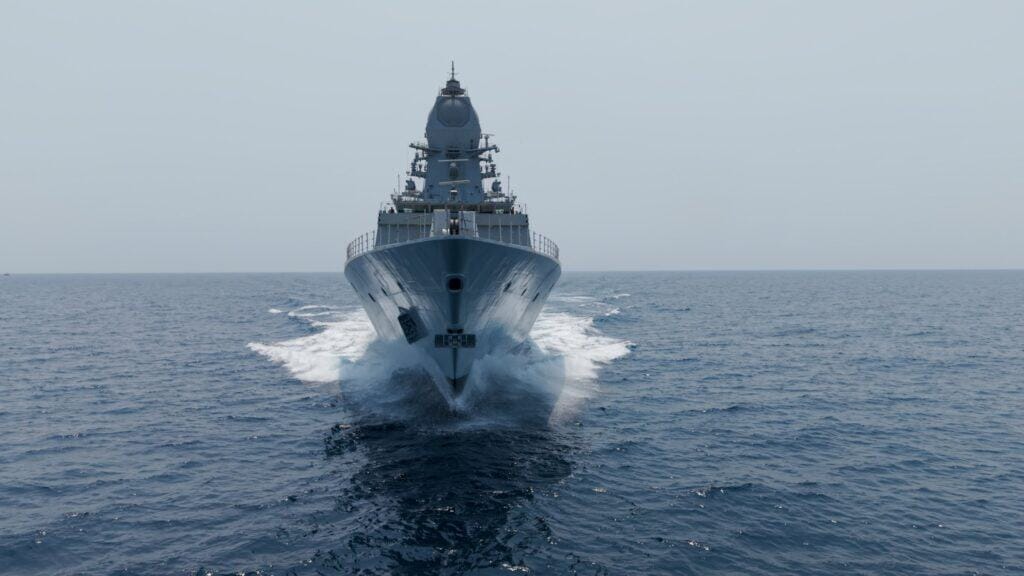

The Indian Navy commissioned INS Mahendragiri, the sixth Project 17A stealth frigate, at Visakhapatnam on 11 July 2026, leaving just one ship of the seven-strong Nilgiri class still to come.
The Indian Navy added fresh muscle to its surface fleet on 11 July 2026. It commissioned INS Mahendragiri at Visakhapatnam, the sixth stealth frigate of the Project 17A programme. Mazagon Dock Shipbuilders in Mumbai delivered the ship on 30 April. Its entry into service leaves only one frigate of the seven-ship class still to come. For a programme that once ran behind schedule, the pace over the past two years marks a clear turnaround.
Mahendragiri is the first Indian warship to carry the name, drawn from a peak in the Eastern Ghats. It joins a class named entirely after Indian mountain ranges. More than the name, the numbers tell the story. The Navy says the frigate carries over 75 per cent indigenous content. Indian firms and smaller suppliers built it under the Aatmanirbhar Bharat push.
What the Project 17A programme is
Project 17A is a roughly 45,000 crore rupees effort to build seven advanced stealth frigates, together known as the Nilgiri class. The Warship Design Bureau, the Navy’s in-house design arm, drew up the ships. Two public shipyards share the work. Mazagon Dock Shipbuilders in Mumbai handles four, while Garden Reach Shipbuilders and Engineers in Kolkata builds three.
The class follows the earlier Shivalik-class frigates and improves on them across the board. The Nilgiri ships carry a lower radar signature, greater automation and a newer mix of weapons and sensors. Each displaces around 6,700 tonnes and stretches close to 150 metres, making them among the largest frigates the Navy has fielded. A Combined Diesel or Gas propulsion system drives them. The ships cruise economically on diesel and sprint on gas turbines when speed matters.
What INS Mahendragiri brings to the water
The Navy describes Mahendragiri as a ship built for the full range of surface operations, from sea control to disaster relief. Its punch comes from a layered weapons fit. The frigate carries BrahMos supersonic cruise missiles for long-range strike, surface-to-air missiles for air defence, a main gun, close-in weapons and a full anti-submarine suite. An integrated combat management system ties the sensors and weapons together, so the crew can fight the ship from a single picture.
Defence reports fill in the detail behind that official summary. They describe eight BrahMos missiles for the anti-ship and land-attack role, backed by a vertical launch system for the Barak-8 air-defence missile. A 76mm main gun and two rapid-fire close-in guns round out the layered defence, while torpedoes and rocket launchers cover the anti-submarine mission. For its eyes, the ship reportedly relies on an Israeli-origin MF-STAR active radar and a hull-mounted sonar. That mix gives it strong reach against both aircraft and submarines.
Stealth sits at the heart of the design. Shaped surfaces, a cleaner profile and careful signature control make the frigate harder to spot on radar. Heavy automation lets a smaller crew run a bigger ship. Those features matter most in contested waters, where seeing first and being seen last can decide the fight.
A build pace that finally matches the ambition
The bigger message from Mahendragiri is momentum. INS Nilgiri, the lead ship, entered service only in January 2025. INS Udaygiri and INS Himgiri followed that August. Taragiri and Dunagiri came next. Mahendragiri makes six frigates in roughly a year and a half, a rhythm the programme struggled to reach in its early years.
Much of that gain traces to how the yards now build ships. Both shipyards moved to modular construction, assembling large pre-outfitted blocks in parallel before joining them, with technical help from an Italian partner. The method cut the time from launch to delivery sharply. It also let work run on several ships at once. The effort fits a wider naval expansion plan that aims for around 200 ships by 2035, where building fast at home matters as much as any single hull.
The firepower question that still hangs over the class
For all its strengths, the class carries one design choice that draws steady debate. Analysts point to the ship’s 32-cell vertical launch capacity for air-defence missiles. They argue it looks modest against the saturation missile attacks a modern frigate may face. A larger magazine would let the ship absorb more incoming threats before it runs dry.
The Navy appears to have heard the criticism. It has already moved on a follow-on class, sometimes called Project 17B, which reports say would carry a bigger vertical launch load and further upgrades. That would keep the design line evolving rather than freezing it at the Nilgiri standard. None of this dulls what Mahendragiri delivers today. It simply marks where the next round of improvement will land.
What comes next
Only one frigate of the seven now remains outside the fleet. INS Vindhyagiri, the final ship and a Garden Reach build, is expected to follow later. Its commissioning would close out a programme that has become a showcase for Indian warship building. Each ship has leaned harder into local content, supplier networks and design ownership. That is exactly the model India wants to carry into future classes.
Mahendragiri’s entry is one ship, but it signals something larger. India is not only buying capability, it is learning to build it at pace, in its own yards, to its own design. The same instinct that drives its push for indigenous fighters and homegrown propulsion now runs through its shipyards. For the Indian Navy, the Nilgiri class shows that self-reliance and firepower can arrive on the same hull.