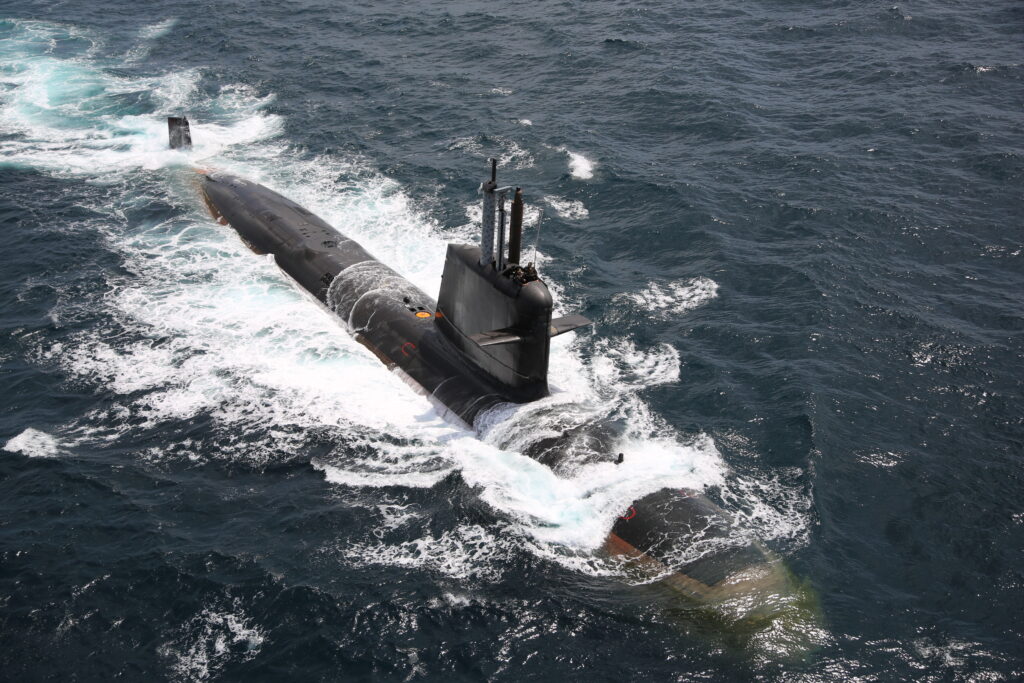

On 8 December 1967, a Soviet-built Foxtrot-class boat entered Indian service as INS Kalvari and the Indian Navy’s submarine fleet was born. Almost exactly fifty years later, a very different Kalvari, a French-designed Scorpène welded together on the banks of the Mumbai harbour, took her place at the head of the line. The name was the same. The predatory spirit behind it was the same; kalvari is the deep-sea tiger shark of the southern Indian coast. Everything else had changed.
That single repeated name carries the whole arc of India’s underwater story. It runs from a young republic buying its first submarines off a foreign production line, through decades of ageing imports and false starts, to a navy now laying down nuclear-powered hunters of its own design. The Indian Navy submarine fleet today sits at the most consequential turning point in its history, caught between a thinning conventional force and one of the most ambitious indigenous shipbuilding pushes any developing power has attempted.
To understand why all of this matters so much, it helps to start not with the boats themselves but with the water they are built to guard.
The Geography That Makes Submarines Essential
Look at a map of the Indian Ocean and India’s problem and its opportunity, becomes obvious. The subcontinent juts a thousand kilometres south into one of the busiest waterways on earth, sitting astride the sea lanes that connect the oil of the Gulf to the factories of East Asia. Indeed, almost everything that keeps the Indian economy running travels across this water. Close to 90 per cent of the country’s trade by volume moves by sea and the great majority of its crude oil arrives in tankers that must pass through a handful of narrow gates.
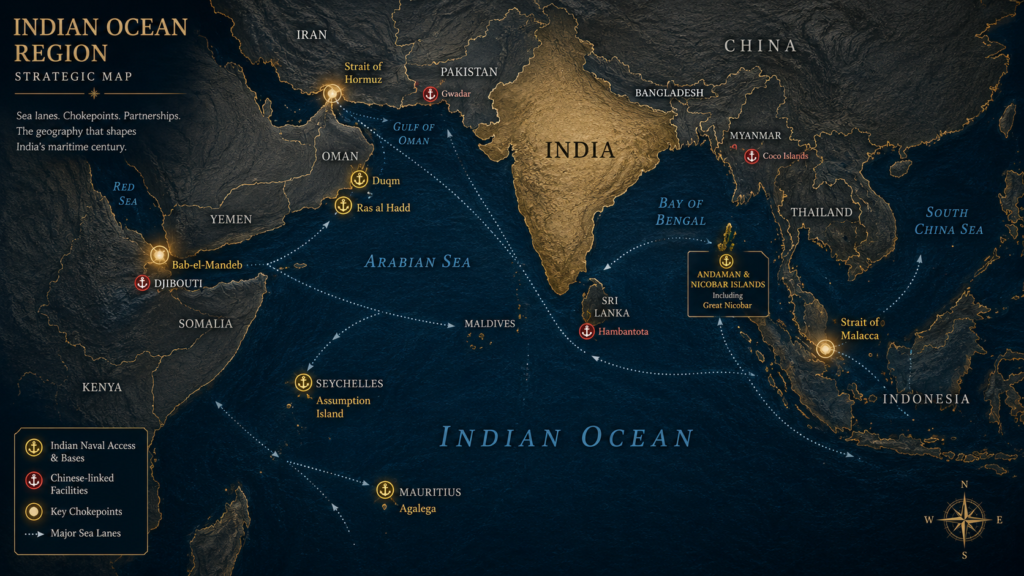
Map: TheNationBrief
The three chokepoints
There are three gates that matter most. To the west lies the Strait of Hormuz, the neck of the Persian Gulf through which much of India’s imported oil flows. Further along the same route sits the Bab-el-Mandeb, the choke point between the Red Sea and the Gulf of Aden that funnels traffic toward the Suez Canal and Europe. Far to the east is the Strait of Malacca, the crowded passage between the Indian Ocean and the South China Sea. It carries the bulk of the trade moving to and from China, Japan and the rest of the Pacific. Whoever can watch, threaten or close these passages holds a hand on the throat of an entire region’s commerce, which is why they sit at the heart of India’s wider maritime strategy in the Indian Ocean.
Why submarines hold the advantage
This is precisely the work submarines do better than any other warship. A surface fleet announces itself and satellites can track a carrier group from space. A submarine simply disappears. One quiet boat loitering off a choke point forces an adversary to treat every sea lane as dangerous, tying down effort in the hunt for a threat that may or may not be there.
In a conflict, a handful of well-placed submarines can hold shipping at risk across thousands of square kilometres without firing a shot and sink it if they choose to. So for a country whose prosperity and war-fighting endurance both depend on keeping these lanes open and on denying them to others, the submarine is not one tool among many. It is the tool.
This is the ocean India’s submariners have always had to hold. How they came to do it is a story that begins, like much of independent India’s defence, with other people’s boats.
The Past: Borrowed Boats and Hard Lessons
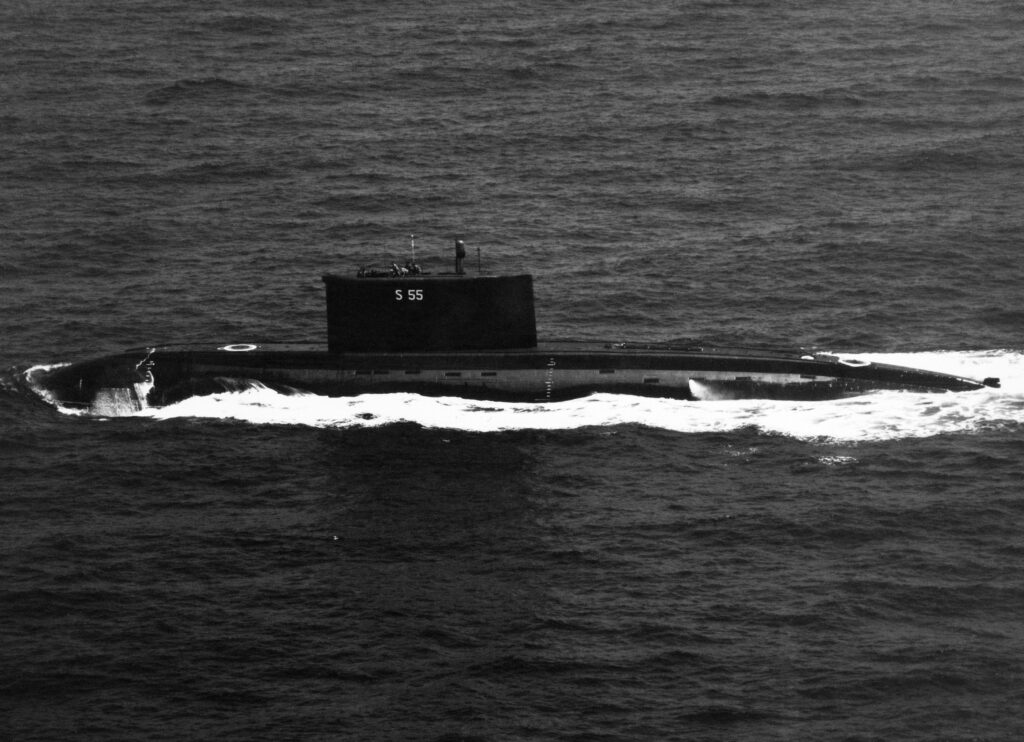
India entered the submarine business late and out of necessity. The 1965 war with Pakistan and Pakistan’s own move to acquire a Daphné-class boat from France, convinced New Delhi that it could no longer treat the deep ocean as someone else’s problem. Moscow offered a way in. Four Foxtrot-class boats of the original Kalvari class arrived between 1967 and 1969, followed by four more of the Vela class. They were noisy by later standards and built for the cold waters of the North Atlantic rather than the warm, layered seas of the Indian Ocean. But they gave a generation of officers their first taste of operating in three dimensions.
The Soviet years
The Soviet relationship deepened through the 1980s with the Sindhughosh class, India’s designation for the Kilo-type Project 877EKM. Quiet, rugged and heavily armed, the Kilos became the backbone of the conventional fleet and remain in service today, several of them refitted and re-armed with the Klub-S cruise missile. For many Indians, the silhouette of a surfaced Kilo at Visakhapatnam is what a submarine looks like.
The German experiment and a lost decade
The decade also brought the country’s first attempt to build rather than buy. A 1981 contract with West Germany’s Howaldtswerke-Deutsche Werft brought the Type 209 to India as the Shishumar class. Howaldtswerke built two boats in Kiel and Mazagon Dock Limited in Mumbai assembled the other two, the first submarines ever put together on Indian soil. It should have been the foundation of a permanent industry. Instead, kickback allegations swirling around the deal poisoned the political atmosphere in the late 1980s. The planned follow-on orders evaporated and the hard-won knowledge at Mazagon Dock drained away. The result was a lost decade. By the time India seriously returned to submarine construction, much of the workforce that had built the Shishumars had retired.
A quiet nuclear apprenticeship
There was a parallel, far quieter thread running through these years. In 1988 India leased a Soviet Charlie-I-class nuclear-powered boat, commissioned her as INS Chakra and for three years a handful of Indian crews learned what it meant to operate a reactor at sea. The boat went back in 1991. Two decades later India repeated the experiment on a larger scale, when an Akula-class boat arrived in 2012 as the second INS Chakra and served until her return to Russia in 2021. Neither boat ever fired a shot in anger. Their value was educational. They taught India how to run, maintain and think about nuclear submarines long before the country could build one and that classroom would matter enormously for what came next.
The Present: A Force Stretched Thin
The Indian Navy submarine fleet of 2026 is a study in contrast. At one end sits a conventional force that is too small and too old. At the other sits a nuclear arm that has just crossed a threshold few nations ever reach.
The conventional backbone
The ageing Kilos and Shishumars still do the daily work of the fleet, but the Navy runs them hard. The modern face of the conventional force is Project 75, the six Kalvari-class boats that Mazagon Dock built under a transfer-of-technology arrangement with France’s Naval Group. Based on the Scorpène design, they brought India back into the business of building submarines after the long post-Shishumar gap. The lead boat, the new INS Kalvari, commissioned in 2017. Khanderi, Karanj, Vela and Vagir followed. Mazagon Dock handed over the sixth and final boat, INS Vagsheer, in January 2025, closing out a programme that ran well over a decade.
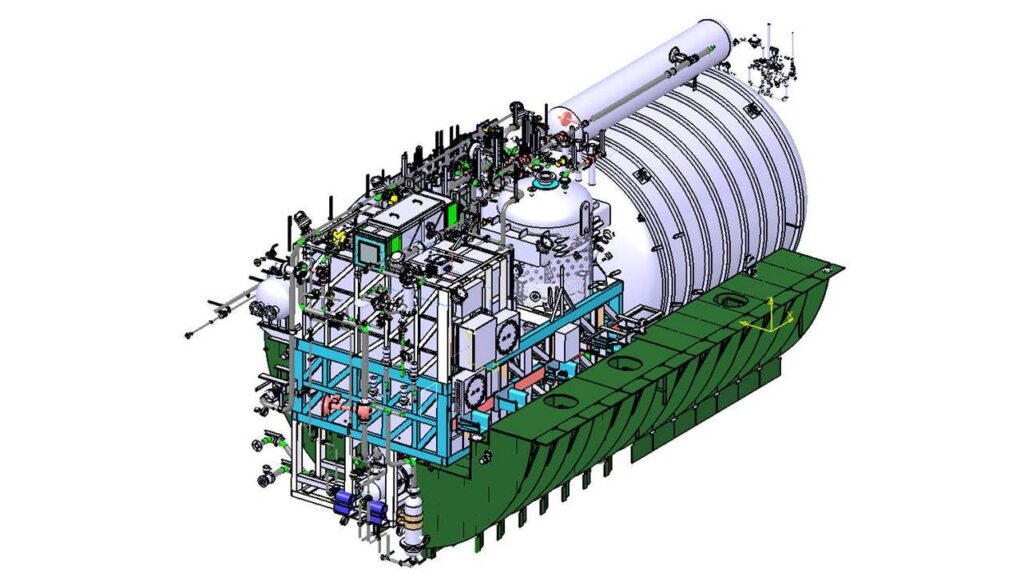
The Kalvaris are quiet, capable and armed with heavyweight torpedoes and tube-launched anti-ship missiles. They have one notable gap. They went to sea without air-independent propulsion, the technology that lets a conventional boat stay submerged for weeks rather than days by generating power without surfacing to run its diesels.
India’s answer is home-grown. The Defence Research and Development Organisation, through its Naval Materials Research Laboratory, has developed a phosphoric-acid fuel-cell AIP module and in 2023 it signed Larsen & Toubro to build the first units. The plan is to cut each Kalvari open during its mid-life refit and insert the AIP plug. INS Khanderi will be the first to receive it, during a refit window around 2026 to 2027. The lead boat, Kalvari, will likely be the last in line, having missed the technology entirely on first build.
The numbers problem
It is worth being honest about the numbers, because the gap is the central fact of the conventional fleet. Back in 1999 the Cabinet Committee on Security signed off on a plan to field two dozen modern conventional submarines by 2030. Yet a quarter century on, the Navy operates around sixteen, many of them well past their prime and on any given day a chunk of that number sits tied up in refit or repair. In early 2026, in a show of strength not seen in roughly three decades, the Navy surged eleven of its sixteen conventional boats to sea at once across the Indian Ocean. The display was impressive precisely because it was so rare and because it left so little in reserve.
China’s expanding underwater presence
The pressure on that thin line is not abstract and it does not come mainly from Pakistan. It comes from the north.
Today China operates the largest navy in the world by number of hulls and its submarine arm has grown faster than any in modern history. United States defence assessments put the People’s Liberation Army Navy’s submarine force at more than sixty boats, with projections of around seventy by 2027 and roughly eighty by 2035. Still, the mix is changing as fast as the count: six Type 094 ballistic missile submarines already conducting deterrent patrols, a growing line of Type 093 nuclear-powered attack boats and newer guided-missile variants and more than fifty conventional submarines, many of them quiet air-independent designs. In fact, China is building nuclear boats at a pace the West has not matched in a generation.
A ring around the ocean
That force no longer stays close to home. Chinese submarines have deployed into the Indian Ocean since around 2013 and 2014, at first under cover of anti-piracy patrols off Somalia, later as a matter of routine.
A hardening network of access points backs that reach. In 2017 China opened its first overseas military base at Djibouti, on the Horn of Africa, almost on top of the Bab-el-Mandeb choke point. To the west of India, the Chinese-operated port at Gwadar in Pakistan, built under the China-Pakistan Economic Corridor, gives Beijing a commercial foothold on the Arabian Sea within reach of the approaches to Hormuz. Indian planners watch it closely for any sign of a naval role. Strung together with port arrangements elsewhere across the region, these footholds form what analysts have long called the string of pearls, a ring of presence around the waters India regards as its own backyard.
Meanwhile, Pakistan compounds the problem closer in. It is taking delivery of eight Hangor-class submarines from China, derived from the Yuan design and fitted with their own air-independent propulsion, a fleet that will give Islamabad a quieter and more numerous underwater force than it has ever had. India therefore faces the prospect of a two-front undersea challenge, a resident and expanding Chinese presence layered over a modernising Pakistani one, at exactly the moment its own conventional fleet is at its thinnest.
The nuclear arm comes of age
If the conventional story is one of strain, the nuclear story is one of arrival. On 3 April 2026, the Indian Navy commissioned INS Aridhaman at Visakhapatnam, the third boat of the Arihant class of nuclear-powered ballistic missile submarines, the platforms that carry the sea-based leg of India’s nuclear triad. She joined INS Arihant, quietly commissioned in 2016 after years as the country’s worst-kept secret and INS Arighaat, inducted in August 2024.
Aridhaman matters for more than the count. At around 7,000 tonnes she is bigger than her two sisters and where the earlier boats carried four vertical launch tubes, she carries eight. The first two boats carried the short-ranged K-15 missile, useful but limited, with much of the relevant geography sitting beyond its 750-kilometre reach. The newer boats carry the K-4, a missile credited with a range of roughly 3,500 kilometres, which transforms the patrol areas from which India can hold a credible threat. A fourth boat of the class is already in sea trials and should follow within a couple of years.
There is a doctrine hidden in those numbers. A survivable sea-based deterrent depends on keeping at least one boat hidden and on patrol at all times, which in practice demands three hulls: one at sea, one in maintenance, one working up. With Aridhaman’s commissioning, India has, for the first time, the arithmetic to claim a genuinely continuous at-sea deterrent rather than an aspirational one. That is the quiet meaning of the spring of 2026.
The missing hunter-killer
What the fleet still lacks is the other kind of nuclear boat, the fast attack submarine, or SSN, that hunts other ships and submarines rather than carrying strategic missiles. Yet India has none of its own. Instead, the stopgap is again a lease from Russia, a refurbished Akula-class boat long promised as the third INS Chakra. That deal dates to 2019, but the war in Ukraine, Western sanctions and Russia’s strained shipyards have pushed delivery out to around 2027 or 2028 and even then the boat will serve as a training and experience platform rather than a frontline combatant. So the lesson India has drawn from the wait is unmistakable. In the end, the future has to be built at home.
India’s Submarine Fleet at a Glance (2026)
For all the programmes and projections, the order of battle today is straightforward. India operates a mixed fleet of roughly nineteen submarines: about sixteen conventional diesel-electric boats across three classes and three nuclear-powered ballistic missile submarines.
| Class | Origin | Type | In service | Status |
|---|---|---|---|---|
| Sindhughosh (Kilo) | Russia / former USSR | Diesel-electric (SSK) | ~7 | Active, oldest hulls over three decades old |
| Shishumar (Type 209) | Germany / India | Diesel-electric (SSK) | 4 | Active, undergoing life-extension refits |
| Kalvari (Scorpène) | France / India | Diesel-electric (SSK) | 6 | Active, newest conventional class |
| Arihant | India | Ballistic missile (SSBN) | 3 | Active, carries the sea-based deterrent |
| Chakra (leased) | Russia | Attack (SSN) | 0 | Next boat expected around 2027 to 2028 |
The single most useful thing to understand about that table is the imbalance buried inside it. Its conventional half is large enough to look respectable on paper, yet too small and too old to meet the tasks the geography demands. The nuclear fleet, by contrast, is young, growing and finally numerous enough to matter. Almost every programme described below is an attempt to fix the first half of that picture without slowing down the second.
Life Inside a Submarine
It is easy to write about submarines as if they were simply weapons systems with names and tonnages. They are also small steel tubes in which human beings live, for weeks at a time, in conditions almost no one else on earth would accept.
A conventional boat like a Kalvari goes to sea with something on the order of forty officers and sailors. A nuclear boat carries closer to a hundred. All of them share a hull narrower than a city bus and packed wall to wall with machinery, pipework, torpedoes and electronics. Space for people is whatever is left over, which is very little. On many boats sailors hot-bunk, two or three men sharing a single rack in rotating shifts so that a bed is never empty and never truly anyone’s. Privacy does not exist. Neither, for the length of a patrol, does sunlight.
Living without daylight
The body loses its bearings quickly, because there is no day and no night; the crew lives by the clock and by artificial lighting that shifts to mark watches. Meanwhile, onboard machinery scrubs and recycles the air and makes and rations the crew’s fresh water. Then the smell of diesel, oil, cooking and too many people in too little space becomes a permanent companion, one the crew stops noticing within hours and visitors never forget. Above all there is the silence. A submarine’s only real defence is staying unheard, so the crew learns to move quietly, fix things quietly and live quietly, knowing a dropped tool at the wrong moment can give the boat away to a listening enemy.
The hardest part is mental
Submariners are volunteers, whom the service selects and trains as much for temperament as for skill, because the job asks a particular kind of person: someone who can stay calm and useful sealed inside a machine that is hundreds of metres underwater, days from help, with no horizon and no way out. The reward is a camaraderie that surface sailors talk about with something close to envy, the bond of people who have trusted one another with their lives in the dark. When a nation talks about its submarine fleet, the steel and the missiles are the easy part. The harder and more important part is finding and keeping the people willing to take it down.
The Future: Learning to Build
India’s submarine future rests on three programmes, layered one above the other like the depths a submarine moves through. One buys time. A second builds the conventional fleet of tomorrow. The third reaches for the top of the undersea food chain.
Project 75I: the bridge
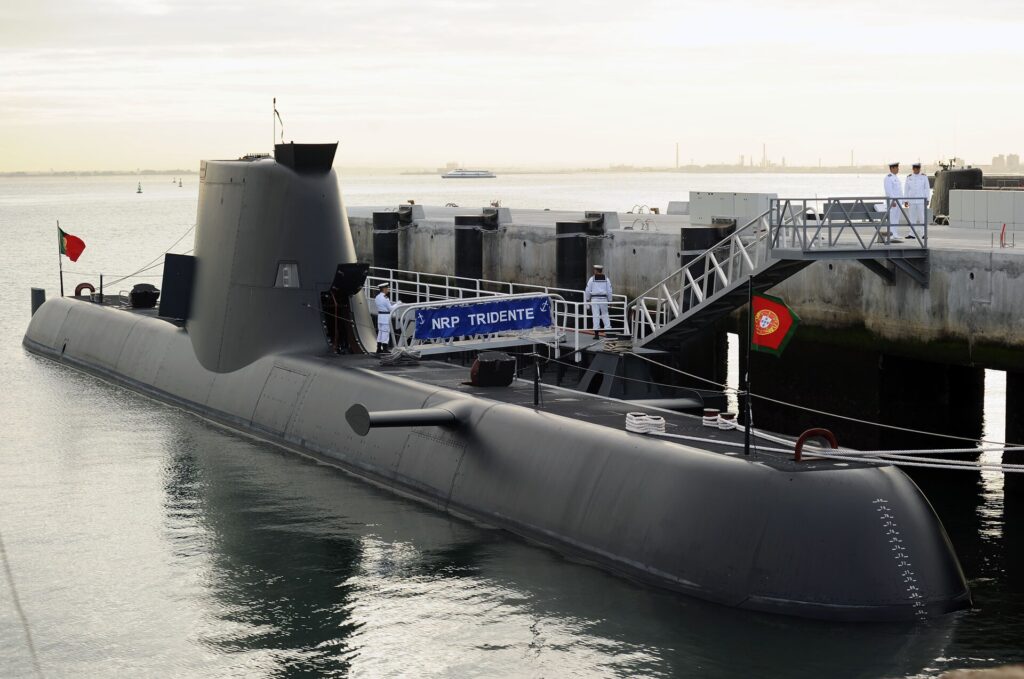
The most immediate of the three is P-75I programme, a long-delayed plan for six conventional submarines with AIP fitted from the keel up rather than retrofitted later. After years of competition that saw Spain’s Navantia and others fall away, the field narrowed to a partnership between Germany’s ThyssenKrupp Marine Systems and Mazagon Dock, drawing on the Type 212 and 214 lineage. By early 2026 the two sides had completed their concept-design work, the cost-and-contract negotiations had closed and the proposal had moved up to the Cabinet Committee on Security for final approval. Reported estimates put the package somewhere around nine to ten billion dollars for the six boats.
Indigenous content is set to rise from roughly 45 per cent on the first hull to about 60 per cent on the last. Even so, industry expects to ink the contract in the financial year spanning 2026 and 2027. For a programme that has been talked about for the better part of two decades, the signature, when it comes, will close a very long chapter.
Project 76: the indigenous leap
In the end, Project 75I is still a foreign design built under licence. Project 76 is meant to be the real break. Led by the Navy’s own Warship Design Bureau alongside DRDO, it aims to produce India’s first wholly home-designed conventional submarine, a boat of around 3,000 tonnes that would succeed the Kilos and stand roughly half again as large as a Kalvari. The propulsion plan is the interesting part: a scaled-up version of DRDO’s indigenous fuel-cell AIP married to lithium-ion batteries. Those batteries give the boat the ability to dump large bursts of power for short, fast sprints in a way older lead-acid cells never could. The armament would be domestic too, with home-built torpedoes and tube-launched cruise missiles for striking targets on land and at sea.
The programme is still in its design phase. Industry figures associated with the effort, including from the private sector, have spoken of finalising the design across 2026 and 2027, with the first boat perhaps six to seven years from delivery once construction begins and an initial run of six boats that could grow. Planners frame Project 76 deliberately as a bridge: a conventional submarine sophisticated enough to share systems and design philosophy with the nuclear attack boats coming behind it, so that the country builds a single coherent submarine industry rather than a series of one-off imports.
Project 77: the hunter-killers
The boldest of the three is Project 77, once known as Project 75 Alpha, the programme to build indigenous nuclear-powered attack submarines. The idea is old; the green light is new. In October 2024 the Cabinet Committee on Security gave final clearance to build the first two of an eventual six SSNs, with a sanctioned cost in the region of 40,000 crore rupees and the rest of the fleet to follow in later batches.
These will be the most complex machines India has ever attempted. Open reporting describes boats of close to 10,000 tonnes, which the Warship Design Bureau is designing for construction at the Ship Building Centre in Visakhapatnam. A new 190-megawatt pressurised light-water reactor from the Bhabha Atomic Research Centre will power them, a generational jump over the smaller reactors in the Arihant-class boats. The design targets speeds above 30 knots and indigenous content of around 95 per cent, with foreign involvement limited mostly to design consultancy. The weapons fit centres on vertical-launch BrahMos cruise missiles, with a clear intention to carry India’s future hypersonic weapons, alongside heavyweight torpedoes for the classic hunter-killer role. Reports put first keel-laying around 2028, with the lead boat unlikely to enter service before the mid-2030s.
The reason for all this sits in the Indian Ocean itself. Chinese nuclear submarines now operate there with growing regularity and a fleet of fast, quiet, long-endurance SSNs is the only conventional answer to that presence that does not depend on permission from anyone abroad. The decades India spent leasing boats from Moscow were, in hindsight, the long apprenticeship for exactly this.
The next generation of deterrent
Above even the SSNs sits the future of the strategic fleet. The Arihant class was always a starting point, a way to learn the craft of building reactors and missile boats. Its follow-on is the planned S5 class, much larger boats of perhaps 13,500 tonnes carrying a more powerful reactor and longer-ranged missiles of the K-5 and K-6 families. The stated ambition is a fleet of six ballistic missile submarines by the middle of the 2030s, enough to hold a permanent and unmistakable deterrent patrol while keeping boats in reserve.
The Long Game
Step back from the individual programmes and a pattern appears. Every line on the chart bends toward building rather than buying. The phosphoric-acid fuel cell, the lithium-ion batteries, the special hull steels coming out of Indian metallurgy labs, the home-grown sonars and combat systems, the reactor work at BARC: each is a piece of an ecosystem that did not exist when the first Kalvari sailed in 1967 and barely existed when the Shishumar line went cold in the late 1980s.
The risks and the direction of travel
The risks are real and worth naming. Indian submarine programmes have a long history of slipping years to the right. Mazagon Dock and the Ship Building Centre can only fabricate so many hulls at once and trying to run Project 75I, Project 76 and Project 77 in parallel will test the country’s industrial capacity to its limits. Meanwhile, the conventional fleet is ageing faster than its replacements are arriving and there is a window in the late 2020s where the numbers look genuinely uncomfortable. The Navy hides none of this and it ignores none of it.
In the decades ahead, aircraft carriers will keep dominating the headlines and destroyers will keep showing the flag in foreign ports, but the truest measure of India’s maritime strength may lie out of sight, beneath the waves. Hidden, patient, armed with longer-reaching missiles and built more and more from Indian steel and Indian ideas, the country’s submarines are turning from imported assets into instruments of national power in their own right. The journey that began with a borrowed Soviet Kalvari in 1967 is slowly becoming a wholly Indian enterprise, one with the reach to help shape the balance of the Indian Ocean for generations to come.