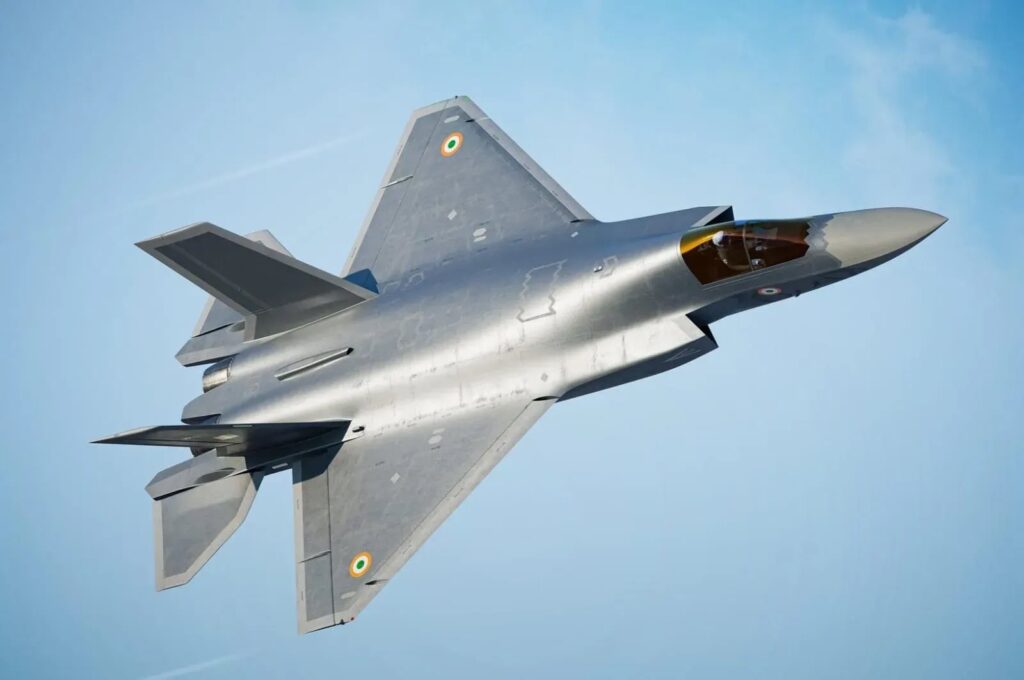

For nearly two decades, India’s ambition to build its own stealth fighter lived mostly on paper, in scale models and in the cautious language of feasibility studies. That has changed. The Advanced Medium Combat Aircraft or AMCA has crossed from concept into commitment and 2026 is the year the programme stopped being a slide deck promise and started looking like an industrial reality.
The evidence is on the ground. The Cabinet Committee on Security has cleared funding. A new execution model has opened the door to private industry. Three heavyweight consortia are now competing to build the prototypes, and the engine question that haunted every previous Indian fighter has finally produced a concrete partner. The Defence Research and Development Organization (DRDO) has put dates on the calendar: a prototype rollout by the end of 2028 and a maiden flight in 2029.
If the AMCA flies on schedule and enters service in the mid-2030s, India joins a very short list. Only the United States, Russia and China have designed and fielded indigenous fifth-generation fighters from scratch. For a country that still imports most of its major weapons, that is no small thing.
This guide breaks down the programme as it stands in 2026: what the AMCA is, why India needs it, where it sits on the development timeline, how its specifications and stealth features hold up, the long-running engine saga, its weapons and avionics, and how it measures against the Rafale, the F-35, China’s J-35 and India’s own Tejas Mk2. We will also look hard at the obstacles that could still slip the schedule, because no honest read of a fifth-generation programme can leave them out.
What Is the AMCA Fighter Jet?
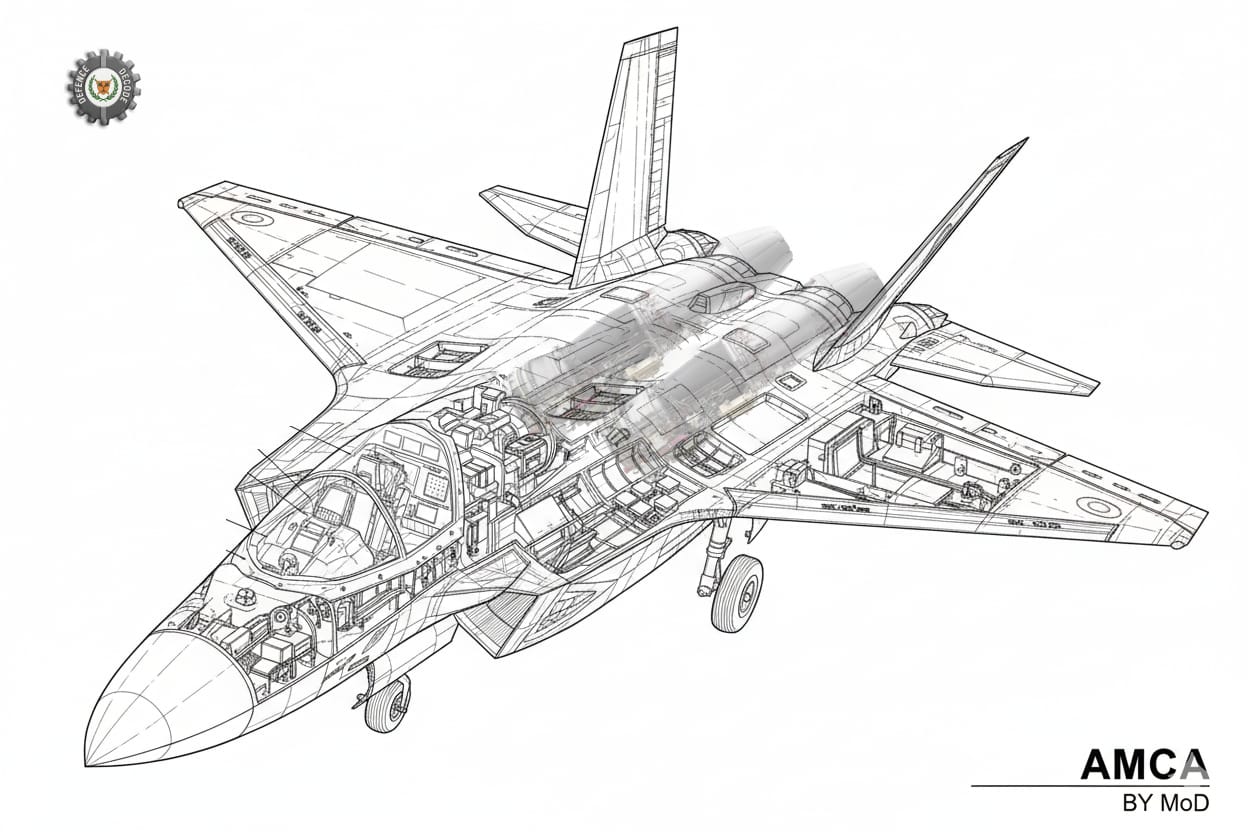
The AMCA is India’s indigenous fifth-generation, single-seat, twin-engine, all-weather stealth multirole fighter. The name lays out the design thinking. “Advanced” points to the generational jump in stealth and sensors. “Medium” places it in the roughly 25-tonne weight class that sits between a light fighter like the Tejas and a heavy platform like the Su-30MKI. “Combat Aircraft” reflects a jet meant to handle air superiority, deep strike, suppression of enemy air defences and electronic warfare.
The Aeronautical Development Agency (ADA), an autonomous design house under the Ministry of Defence that also fathered the Tejas, leads the design. The DRDO provides the wider scientific backbone, including radar, materials and weapons work spread across its network of laboratories. Hindustan Aeronautics Limited (HAL) has been the traditional production partner for Indian military aircraft, but the AMCA breaks deliberately from the HAL-only model. Under the programme’s execution structure, private industry now competes on equal footing to build the jet.
The goals are easy to state and brutally hard to deliver. India wants a genuine low-observable platform with internal weapons carriage, deep sensor fusion, supercruise in later variants and the networked, AI-assisted cockpit that defines modern air combat. It wants to own the technology rather than rent it, so upgrades, exports and derivatives stay under Indian control.
Within India’s air power plans, the AMCA sits at the top of a tiered fleet. The Tejas family covers the lighter end. The Rafale supplies a 4.5-generation punch in the near term. The AMCA is meant to be the stealthy spearhead that penetrates defended airspace where non-stealthy aircraft would struggle to survive.
Why India Needs the AMCA
The case for the AMCA has only sharpened over the past two years. The Indian Air Force is flying well below its sanctioned strength of 42 fighter squadrons, hovering around 31 as ageing MiG-21s retire and replacements trickle in. That gap is not academic. It is a real shortfall in combat mass at a moment when India faces a two-front problem.
To the north, China has deployed its J-20 in numbers and is pushing the J-35, a medium stealth fighter Beijing has been marketing for export. More telling still, China publicly flew two sixth-generation prototype designs, informally tagged the J-36 and J-50, in late 2024. That pace has rattled planners across Asia. To the west, reports that Pakistan is interested in buying the J-35 raise the prospect of a stealth-capable adversary on India’s other flank, which would erode the qualitative edge the IAF has long counted on.
Air combat itself is changing shape. The premium now sits on surviving in heavily defended airspace, on fusing a battlefield’s worth of data without drowning the pilot in it, and on teaming a fighter with the drones flying alongside it. You cannot retrofit a fourth-generation airframe into a true low-observable jet. India needs a clean-sheet stealth design to stay in the fight.
Then there is dependence. India remains one of the world’s largest arms importers, and every foreign fighter buy carries strings: licensing limits, supply-chain exposure, and constraints on how and where the aircraft can be modified or sold on. A working AMCA cuts that exposure. It also builds the aerospace muscle no country can simply purchase: design teams, test infrastructure, materials science, a supplier base. Those skills compound, and they feed directly into whatever sixth-generation effort follows.
AMCA Development Timeline
Early Concept and Design Phase
The AMCA’s roots reach back to the early 2010s, when the IAF and ADA ran feasibility studies after India’s separate fifth-generation collaboration with Russia stalled and was eventually shelved. Those studies fed a detailed design phase that ran for the better part of a decade, refining the airframe shape, the internal weapons bay and the low-observable configuration through long hours of wind-tunnel and computational work.
Government Approval and Funding
The decisive political moment came in March 2024. The Cabinet Committee on Security formally approved the programme and sanctioned roughly ₹15,000 crore, about $1.8 billion, for design and prototype development. That approval turned years of study into a funded project with a mandate to build flying hardware.
Prototype Development
The next turn came in May 2025, when the Defence Ministry approved a new execution model. For the first time in a programme of this scale, public and private players received an equal opportunity to compete for the aircraft’s development. By 2026 that model had produced a real contest. Three consortia were shortlisted to develop the prototypes: Tata Advanced Systems bidding on its own, a Larsen & Toubro-Bharat Electronics group, and a consortium led by Bharat Forge with BEML and Data Patterns. Two of the three mix public and private participation; one is entirely private. The Ministry moved to issue requests for proposal, with final selection resting on the commercial bids. A full-scale engineering model from Hyderabad-based VEM Technologies went on public display at Aero India 2025. Built using indigenous composites, it provided visible evidence that the design had moved beyond studies and into physical development.
Testing and Validation
Five flying prototypes plus a structural test specimen are planned, each prototype costing on the order of ₹1,000 crore. The validation effort leans heavily on the flight-test infrastructure and the lessons banked during the Tejas years, including a dedicated Aircraft Integration and Flight Testing Centre set up to speed integration, testing and certification. India has also broken ground on a manufacturing and development hub tied to the programme, laying the industrial base that serial production will demand.
Expected First Flight
DRDO Chairman Dr Samir V. Kamat has given the clearest markers yet. The first prototype is expected to roll out by the end of 2028, with the maiden flight following in 2029. Rolling out and flying within roughly a year of each other reflects a deliberate push to run design freeze, subsystem development and industrial preparation in parallel, sparing the AMCA the long, morale-sapping gaps that dogged earlier Indian aircraft.
Planned Induction Timeline
Past the maiden flight, the roadmap targets a fleet of five flying prototypes by around 2032, certification in the early 2030s, and serial production leading to induction in the 2034 to 2035 window. The IAF has flagged a requirement for roughly 120 to 126 aircraft, organised into about seven squadrons, which would make the AMCA the backbone of its combat fleet. These dates are bold for a first indigenous stealth fighter, and history suggests some slip is likely. The difference now is that the programme has the funding, the partners and the political momentum earlier timelines never had.
AMCA Specifications
Dimensions and Airframe
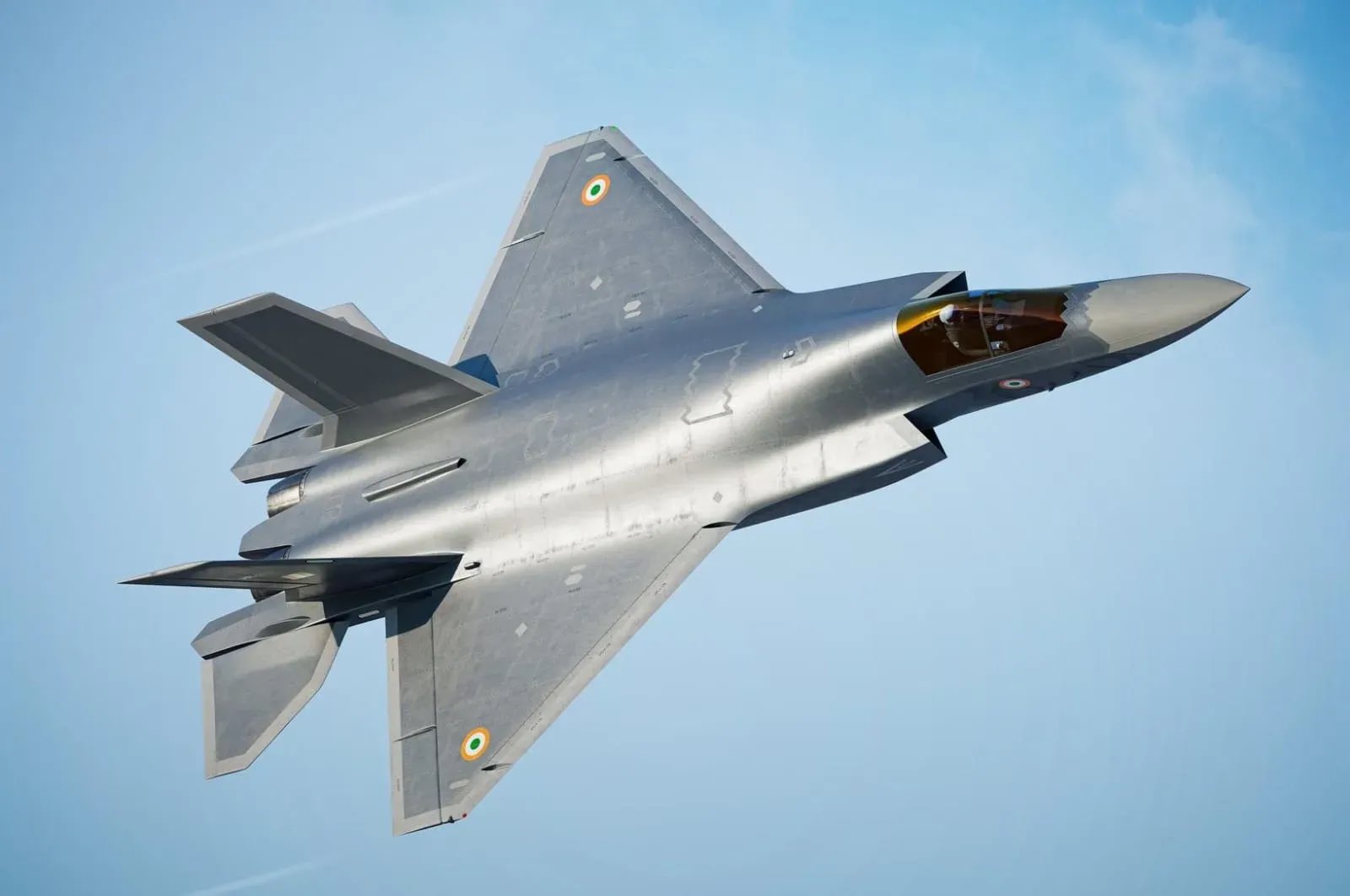
The AMCA is a medium-weight, twin-engine design built around a maximum take-off weight of about 25 tonnes and an empty weight near 12 tonnes. The airframe uses a blended, faceted shape with twin canted vertical tails and an internal weapons bay carried at the centre of mass, a layout dictated almost entirely by stealth. Heavy use of indigenous composites helps hold the weight down and feeds the low-observable design.
Maximum Speed
The jet is expected to exceed Mach 1.8. Top speed matters less than supercruise, the ability to hold supersonic flight without afterburner, which is planned for later variants once the more powerful indigenous engine arrives. Supercruise stretches effective range and trims the infrared signature that afterburners throw off.
Combat Radius
A combat radius beyond 1,000 kilometres is planned, figured to include transit, time on station and a representative internal load of beyond-visual-range missiles and guided bombs. That reach is what makes deep penetration a real mission profile rather than a marketing line.
Service Ceiling
As a high-performance stealth fighter in the 25-tonne class, the AMCA is designed to work across the full altitude band expected of a modern multirole platform, with strong high-altitude performance supporting both interception and stand-off strike. Precise numbers will firm up through flight testing.
Payload Capacity
The internal bay is sized for roughly 1,500 kg of armament in full stealth configuration. Open-source figures put the bay at about 4.2 metres long, 2.2 metres wide and 0.75 metres deep. In non-stealth mode the aircraft can hang over five tonnes of extra weapons on six external hardpoints, trading low observability for raw firepower when the threat allows. The bay can also be reconfigured to carry fuel in place of weapons, extending range without the radar signature of external stores.
Expected Performance Characteristics
The AMCA carries about 6.5 tonnes of fuel internally. This gives it a generous fuel fraction and supports its long range ambitions. Projected unit cost falls in the $100 to $120 million range, depending on configuration and engine. Read together, the numbers describe a balanced multirole stealth fighter rather than a single-mission specialist, a deliberate call for an air force that needs flexibility across a wide threat spectrum.
Stealth Features of the AMCA
Low Radar Cross Section Design
Stealth starts with shape. The AMCA’s faceted, carefully aligned airframe is built to scatter incoming radar energy away from its source rather than bounce it straight back, cutting the radar cross section an enemy receiver sees. Edge alignment, serrated panel joints and buried engine inlets that hide the compressor faces all help make the jet hard to detect and harder still to lock for a shot.
Internal Weapons Bay
Carrying weapons internally is non negotiable for a true stealth fighter. External missiles and bombs create large radar signatures that can compromise low observability. The AMCA’s central ventral bay keeps its primary weapons hidden and preserves its stealth profile. This allows the aircraft to operate more effectively inside heavily defended airspace. The trade-off is limited internal space. That is why the AMCA also features external hardpoints for missions where stealth is less critical.
Radar Absorbent Materials
Beyond shape, the AMCA relies on radar-absorbent materials and coatings that absorb electromagnetic energy rather than reflect it. India has invested heavily in the materials science behind these technologies. The indigenous composite construction showcased on the engineering model reflects that effort. Material stealth and geometric stealth work together to reduce detectability. Neither approach can provide sufficient protection on its own against modern multi-band radars.
Infrared Signature Reduction
A stealth aircraft must evade infrared sensors as effectively as it avoids radar detection. To achieve this, the AMCA manages exhaust heat and reduces its infrared signature. In addition the planned indigenous engine is expected to feature a variable-geometry afterburner. This system can optimize thrust while reducing infrared emissions across different flight conditions. Furthermore, supercruise reduces the need for afterburner use. As a result, the aircraft generates less heat and becomes harder for heat-seeking missiles to detect and track.
Survivability Enhancements
Survivability involves more than staying hidden from enemy sensors. The AMCA combines stealth with advanced electronic warfare systems and strong situational awareness. It can also network with other platforms and unmanned wingmen during combat operations. As a result, the aircraft can jam threats, evade attacks, or engage targets first even after detection. Moreover, low observability works alongside sensor fusion and networked support to improve battlefield effectiveness. Together, these capabilities make a fifth-generation fighter far more difficult to defeat than conventional aircraft.
AMCA Engine Program
Initial Engine Configuration
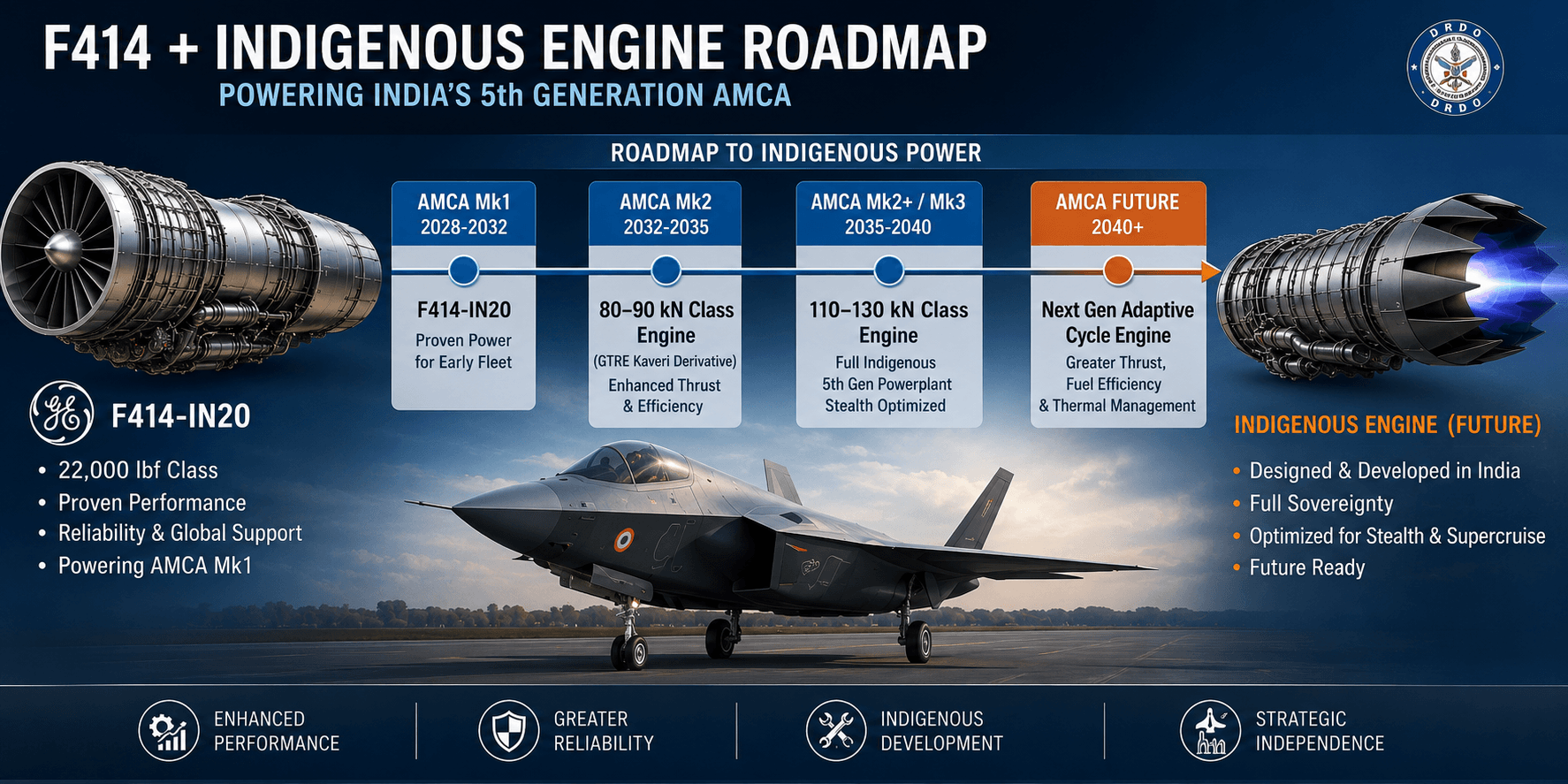
Propulsion has long been one of the biggest challenges in India’s fighter aircraft programme’s. As a result, the engine remains one of the most critical elements of the AMCA project. The first production variant, the AMCA Mk1, will use two General Electric F414 engines. Notably, the same engine family has also been selected for the Tejas Mk2. The F414 is a mature and reliable powerplant that produces roughly 98 kN of thrust. By using a proven engine, India can reduce technical risks and keep the flight-test schedule on track. Consequently, the programme can focus more resources on validating the airframe, avionics and stealth technologies.
GE F414 Engine Partnership
The decision to use the F414 is a practical one. Instead of waiting for an indigenous engine to mature, India will power the AMCA Mk1 with a proven platform. At the same time negotiations for licensed F414 production in India support the broader goal of strengthening domestic engine manufacturing. This approach reduces development risk and keeps the airframe programme moving forward. More importantly, it allows engineers to focus on flight testing and systems integration. Meanwhile, work on the indigenous engine can continue without delaying the AMCA’s initial deployment.
Indigenous Engine Development Plans
The long-term prize is a homegrown engine. In August 2025 India took its boldest step yet, moving decisively toward France’s Safran as the preferred partner to co-develop a new 120 kN-class turbofan for the AMCA under the broader India-France Horizon 2047 partnership. Reports valued that proposal at roughly ₹61,000 crore or about $7 billion, built around a full transfer of technology with India keeping the intellectual property rights. That last point separates it from earlier arrangements where India largely assembled engines designed elsewhere. The picture has since reopened. Britain’s Rolls-Royce has mounted a strong competing bid. As of mid-2026 India has signed no final deal, which leaves the choice between Safran and Rolls-Royce still open. On the Indian side the Gas Turbine Research Establishment (GTRE) leads the effort, drawing on indigenous single-crystal turbine-blade metallurgy developed by the Defence Metallurgical Research Laboratory, the kind of high-temperature materials know-how that divides serious engine nations from the rest. To pull the wider effort together, India launched a National Aero Engine Mission in early 2026.
Future Engine Roadmap for AMCA Mk2
This 120 kN engine will power the AMCA Mk2, the variant where India’s engine sovereignty becomes real. Development is expected to take around a decade, with core engine runs targeted in the early 2030s and serial production toward mid-decade. Safran has said the design scales toward 140 kN, opening the door to heavier AMCA derivatives and laying a foundation that could feed a sixth-generation fighter. The catch is timing. Some assessments warn that engine validation could stretch toward the late 2030s, which would push Mk2 induction toward 2040. Engine development is unforgiving, and this is the part of the programme most likely to slip.
Avionics and Sensor Suite
AESA Radar
At the heart of the AMCA’s sensor suite is an indigenous active electronically scanned array (AESA) radar. Unlike older mechanically scanned radars, an AESA can steer its beam electronically across hundreds of transmit-receive modules. As a result, it can track multiple targets simultaneously, resist jamming, and switch quickly between air and ground missions. For a stealth fighter, the radar plays a critical role in the kill chain. It helps the aircraft detect, track, and engage threats before an adversary can respond.
Sensor Fusion
What really sets a fifth-generation aircraft apart is not any single sensor but the way it fuses all of them. The AMCA blends radar, electro-optical, infrared and electronic-warfare inputs into one coherent picture for the pilot. Instead of forcing the pilot to read separate feeds, fusion presents a single battlespace view, cutting workload and speeding the decisions that win or lose an engagement in seconds.
Electronic Warfare Systems
A full electronic warfare suite gives the AMCA the means to spot, identify and counter hostile radars and missiles. Radar warning, jamming and self-protection systems work alongside stealth to keep the jet alive in heavily defended airspace. In a contested fight, the EW suite matters as much to survival as the airframe shaping.
Advanced Cockpit Technologies
The cockpit is being built around a large-area display, modern human-machine interfaces and AI-assisted decision aids meant to lighten the pilot’s load. The aim is a cockpit that handles routine tasks and threat prioritization so the pilot can focus on tactics and command calls, including, in time, directing unmanned wingmen.
Situational Awareness Capabilities
Tying it together is a networked platform that shares data across a force. Resilient communications and data links let the AMCA act as a node in a larger sensor and shooter web, feeding and drawing from a shared operating picture. In modern air war, the side that sees first and shares fastest usually wins and the AMCA is built around that idea.
Weapons and Combat Capability
Air-to-Air Missiles
For beyond-visual-range work, the AMCA will carry India’s indigenous Astra family of air-to-air missiles, with the longer-range, ramjet-powered Astra Mk3, recently renamed Gandiva, extending its reach well out. Carrying these missiles internally preserves stealth, letting the AMCA shoot from inside defended airspace where a non-stealthy fighter could not safely go.
Air-to-Ground Weapons
The jet is built for deep strike and ground attack, carrying precision-guided bombs and stand-off weapons. DRDO is also developing a compact, stealth-shaped, ramjet-powered cruise missile sized to fit the AMCA’s internal bay, drawing on the propulsion work behind the Astra Mk3. That weapon, still years from service, reflects a clear plan to build an entirely indigenous fifth-generation weapons supply chain.
Precision-Guided Munitions
Across air and ground roles, the emphasis falls on precision. Laser-guided and satellite-guided munitions, anti-radiation missiles for suppressing enemy air defences, and other smart weapons give the AMCA the accuracy expected of a modern multirole fighter, while internal carriage keeps the signature low through the critical penetration phase of a mission.
Internal and External Weapon Configurations
The AMCA’s flexibility comes from its dual carriage approach. In stealth mode it holds about 1.5 tonnes internally, keeping its signature low. When the threat is permissive six external hardpoints add over five tonnes of ordnance. The bay can even swap weapons for fuel, trading firepower for range without breaking the radar signature, a smart piece of design that lets one airframe serve very different missions.
AMCA Variants
AMCA Mk1
The Mk1 is the first production configuration, powered by GE F414 engines. It locks in the airframe, the stealth shaping, the sensor suite and the weapons integration and it will equip the opening squadrons. Think of it as the version that proves the concept and gets the jet into service while the indigenous engine matures.
AMCA Mk2
The Mk2 is the harder hitting evolution built around the 120 kN indigenous engine co-developed with Safran. The extra thrust unlocks fuller super cruise, heavier payloads and the energy a true air-superiority stealth fighter demands. The Mk2 is where the programme’s self-reliance goal lands in full, though its timeline rides on the slower engine effort and could run toward the end of the 2030s.
Potential Future Variants
Looking further out the engine’s scalability toward 140 kN opens the door to heavier AMCA derivatives. There has been active talk of a larger, roughly 27-tonne variant distinct from the baseline 25-tonne jet, and the engine core is explicitly positioned as a starting point for India’s sixth-generation fighter. Naval interest in a carrier-capable version has also been part of the conversation, a sign of how long the platform is meant to last.
AMCA vs Tejas Mk2
The AMCA and the Tejas Mk2 complement each other rather than compete and the distinction explains India’s whole fighter plan. The Tejas Mk2 is a 4.5-generation medium-weight fighter, a substantial upgrade of the Tejas line but fundamentally a refined, non-stealth platform tuned for affordable multirole work. The AMCA is a clean-sheet fifth-generation stealth design.
In mission terms, the Tejas Mk2 carries the bulk of daily air defence and strike tasking cheaply and in numbers, while the AMCA stays the stealthy spearhead held back for the most heavily defended airspace. The technical gap is generational: the AMCA’s internal weapons carriage, low-observable shaping and deeper sensor fusion put it in another class. The two are meant to fly together, the Tejas Mk2 providing mass, the AMCA providing the means to kick down the door.
AMCA vs Rafale
The Rafale provides a useful benchmark because it already serves in the Indian Air Force. The French-built aircraft is a highly capable 4.5-generation multirole fighter. It is combat-proven, mature and available today. The AMCA cannot yet make those claims. The Rafale’s biggest strength is its operational readiness, supported by deep weapons integration and a strong industrial ecosystem.
The AMCA’s advantage lies in its generation. The Rafale relies on agility, advanced sensors and electronic warfare systems to survive in contested environments. However, it carries its weapons externally and lacks true low-observable shaping. As a result enemy radars can detect it at greater distances than a stealth fighter. The AMCA is designed to detect threats first and engage them before an adversary can respond.
Ownership also sets the two aircraft apart. India imports the Rafale and must operate within the constraints of a foreign platform. The AMCA, if successful, will remain under Indian control. India will be able to upgrade, modify and potentially export the aircraft on its own terms. For now both fighters will operate alongside each other. The Rafale will provide immediate capability while the AMCA gradually enters service.
AMCA vs J-35
The comparison that matters most is with China’s Shenyang J-35. It is the stealth fighter India is most likely to face across the northern border and potentially in Pakistani service to the west.
Both aircraft belong to a similar category. They are medium-weight, twin-engine, and low-observable designs. On paper, the gap between them appears narrower than India’s broader airpower balance with China might suggest. The key differentiators are sensors, avionics, and engines.
China currently holds a significant advantage. The J-35 is already flying and entering service, while the AMCA remains several years away from its first flight. That maturity gap is difficult to ignore.
India’s strengths lie in sensor fusion, electronic warfare, and indigenous weapons. The AMCA’s AESA radar and Astra missile family could provide a competitive edge in these areas. The engine remains the biggest uncertainty. China has faced long-standing challenges with high-performance turbofans. India’s partnership with Safran could help narrow that gap if the programme meets its goals.
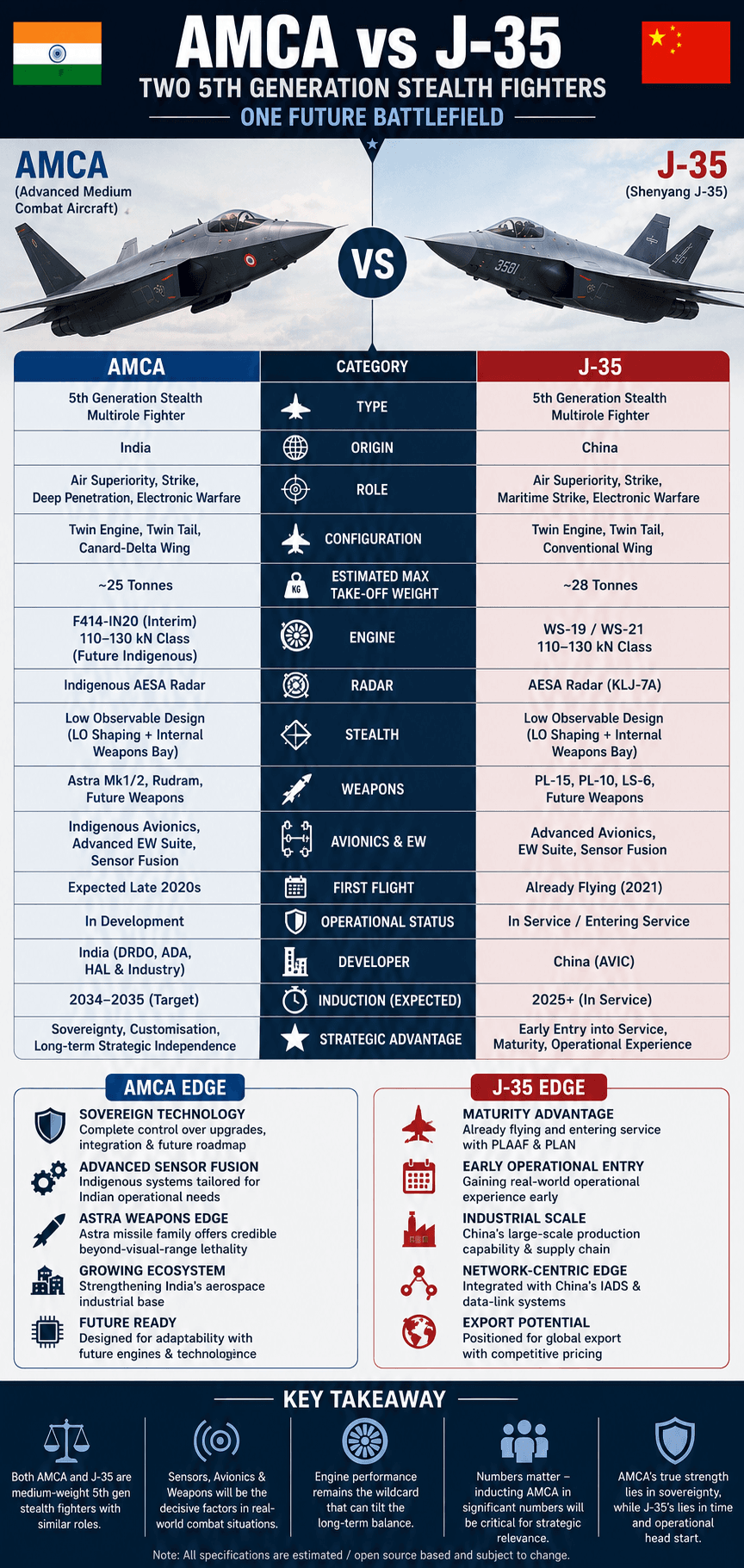
Ultimately, the AMCA’s success will depend less on matching the J-35 feature for feature and more on entering service in meaningful numbers. That requirement explains the urgency behind the programme’s current timeline.
AMCA vs F-35
Comparing the AMCA with the American F-35 reveals two very different design philosophies. The F-35 is a single-engine, fusion-centric stealth fighter. It has been produced and exported in large numbers. In addition, it benefits from a mature global support ecosystem and nearly two decades of operational experience. As a result, it remains the most widely produced fifth-generation fighter in the world.
The AMCA follows a different approach. It uses a twin-engine configuration to improve redundancy and performance. Moreover, it combines a medium-weight design with a strong focus on air superiority and deep-strike missions. On raw capability, the F-35 currently holds the advantage. It benefits from proven sensors, integrated logistics, and extensive operational experience.
However, capability alone does not tell the full story. The F-35 is not available to India on terms that support long-term strategic autonomy. Even where it is offered, it comes with significant restrictions on data access, maintenance, and sovereignty. In contrast, the AMCA focuses on independence and affordability. India will retain control over the technology and gain the freedom to upgrade, modify, and potentially export the aircraft. Ultimately, the AMCA does not need to outperform the F-35 in every category. Instead, it must provide India with a capable fifth-generation fighter that remains fully under national control.
Role of DRDO in the AMCA Program
The DRDO serves as the scientific backbone of the AMCA programme. Through the Aeronautical Development Agency (ADA), it leads the aircraft’s design and development. In addition, its network of laboratories develops many of the technologies required for a fifth-generation fighter. These include the AESA radar, advanced airframe materials, stealth treatments, propulsion systems, and indigenous weapons.
The organisation also brings decades of aerospace experience to the programme. It has accumulated valuable lessons from the Tejas project in areas such as flight testing, certification, and programme management. As a result, the DRDO is applying that experience to streamline AMCA development and reduce potential delays.
Moreover, the organisation’s leadership has outlined specific milestones and timelines. This level of transparency suggests a more disciplined approach than many earlier Indian aerospace programmes. Consequently, the AMCA appears to be operating under a stronger execution framework than its predecessors.
Role of HAL in the AMCA Program
HAL has served as India’s leading military aircraft manufacturer for decades. As a result it remains a key part of the AMCA programme’s industrial framework. However the new execution model ends HAL’s traditional monopoly. Under this structure HAL competes directly with private-sector companies for major programme responsibilities.
The three shortlisted prototype consortia reflect this shift. Several groups combine HAL’s manufacturing expertise with the speed and flexibility of private industry. Consequently the programme encourages greater competition and distributes work across a broader industrial base. This approach also helps reduce the bottlenecks that affected earlier aerospace projects.
HAL’s experience remains a major advantage. The company brings decades of expertise in airframe production, systems integration, and engine manufacturing. Its work on the F404 and F414 programme’s further strengthens its credentials. Nevertheless HAL now operates within a more competitive ecosystem that includes a growing number of private aerospace players.
Challenges Facing the AMCA Program
Engine Development
The engine is the defining risk. India has never developed and fielded a high thrust fighter engine and the indigenous Kaveri programme’s long struggles stand as a warning. The Safran partnership de risks the Mk2 engine a great deal but co-developing a 120 kN turbofan with full technology transfer is a decade long job with real schedule risk and any slip cascades straight into Mk2 induction.
Technology Integration
Folding stealth shaping, an indigenous AESA radar, sensor fusion, electronic warfare and a new weapons suite into one coherent platform is brutally demanding. Each subsystem is hard on its own; making them work together as a fused whole is harder and it is where first-time stealth developers usually hit the ugliest surprises.
Testing and Certification
Flight testing and certifying a stealth fighter is a multi-year grind that needs specialized infrastructure and expertise. India is building dedicated integration and flight test facilities precisely to compress this phase but certifying low-observable performance, weapons separation from internal bays and the full flight envelope of a new airframe cannot be rushed without buying risk.
Production and Manufacturing Challenges
Finally the programme has to turn prototypes into series production at quality and scale. Stealth aircraft demand exacting tolerances, specialized materials handling and a mature supplier base, much of which India is building in parallel with the jet itself. The private led model is meant to ease capacity, but standing up a fifth-generation production line is a formidable industrial task in its own right.
Strategic Impact of the AMCA Program
Strengthening India’s Air Power
A fleet of roughly 120 stealth fighters would reshape the IAF’s high end punch, handing it a jet that can work in airspace its current fighters could not survive. That counts for a great deal against an adversary fielding its own stealth aircraft and it helps fill the squadron shortfall with quality while the IAF works to rebuild quantity.
Indigenous Defence Manufacturing
The AMCA is a flagship for India’s atmanirbhar drive in defence. Developing the airframe, radar, weapons and eventually the engine at home keeps the technology in Indian hands and loosens the grip of foreign suppliers and the constraints they impose. The programme is as much an industrial policy statement as a military one.
Aerospace Ecosystem Growth
The most durable payoff may be the ecosystem the programme builds. Design teams, test infrastructure, materials science, precision manufacturing and a deep supplier network are assets that once stood up feed every project that follows. The skills forged on the AMCA will shape India’s sixth-generation work and its wider aerospace industry for years.
Future Roadmap
The near term markers are concrete and closely watched: selection of the prototype building consortium, the first prototype rollout targeted for end 2028 and the maiden flight in 2029. Past that lie the build-up to five flying prototypes, certification and induction of the Mk1 in the mid 2030s.
The longer arc turns on the indigenous engine. As the Safran-co-developed 120 kN turbofan matures toward the late 2030s it will enable the Mk2 and its fuller super cruise and payload and its scalability toward 140 kN opens the door to heavier derivatives. The technology laid down here, in propulsion, stealth, sensors and manned unmanned teaming, is meant to feed India’s sixth-generation fighter. The AMCA then is not just an aircraft but a launchpad for a generation of indigenous combat aviation and the long view is plain: a permanent place among the handful of nations that can design world class fighters from a blank sheet.
Frequently Asked Questions (FAQ)
Is AMCA a fifth-generation fighter aircraft?
Yes. The AMCA is designed as a genuine fifth-generation fighter, carrying the defining traits of that class: low observable stealth shaping and materials, internal weapons bay, deep sensor fusion, an AESA radar, super cruise in later variants and networked AI-assisted operations.
When is the AMCA expected to enter service?
The DRDO targets a first prototype rollout by the end of 2028 and a maiden flight in 2029. Serial production and induction of the Mk1 are expected in the 2034 to 2035 window, with the more capable Mk2 following later, depending on the indigenous engine’s progress.
Which engine will power the AMCA?
The first AMCA Mk1 will use two American GE F414 engines. The Mk2 will fly on a 120 kN class engine being co-developed with France’s Safran under a roughly $7 billion deal that includes full technology transfer and Indian ownership of the intellectual property.
How does the AMCA compare to the F-35?
The F-35 is a mature, combat-proven, single-engine stealth fighter built in large numbers, and on raw capability it leads today. The AMCA is a twin-engine, medium-weight design whose value lies in sovereignty, a lower projected price and freedom from the constraints that come with importing foreign stealth aircraft. The AMCA aims to give India an independent fifth-generation jet rather than to outperform the F-35 spec for spec.
What is the difference between AMCA Mk1 and Mk2?
The Mk1 uses imported GE F414 engines and establishes the airframe, stealth, sensors and weapons. The Mk2 is the harder hitting evolution built around the indigenous 120 kN engine, delivering more thrust, fuller super cruise and heavier payloads. The Mk2 fully realizes the programme’s self-reliance goal but runs on a longer timeline tied to engine development.
Will the AMCA be exported in the future?
India has signaled its intent to allow AMCA exports. Once the jet is in service and export clearances are secured the consortium building it would be free to market it abroad, positioning the AMCA as a relatively affordable fifth-generation option on the world market.
Conclusion
The AMCA has reached the most credible point in its history. The money is in place, a competitive industrial model is choosing who will build it, the engine question has at last produced a serious partner and the DRDO has committed to dates it expects to hit. After years when India’s stealth fighter ambition was easy to dismiss as forever five years away, 2026 finds the programme commissioning prototypes with a maiden flight on a near horizon.
The stakes are not in doubt. A two front threat, a shrinking squadron count and the spread of stealth aircraft around India’s neighbourhood make an indigenous fifth-generation fighter a necessity rather than a luxury. The AMCA stands to sharpen the IAF’s high end punch, anchor a atmanirbhar defence industry and build an aerospace base whose returns will outlast the aircraft.
The obstacles are just as real and the engine remains the thread on which the boldest goals hang. Schedules for first-of-kind stealth fighters slip more often than they hold and a measure of caution about the dates is warranted. Even so the direction is unmistakable. If India delivers even a fair share of what the AMCA promises it will have done something only three other nations have managed and it will have changed the course of its air power for a generation. The next three years leading to that 2029 first flight will tell us whether the promise becomes an aircraft on the runway.