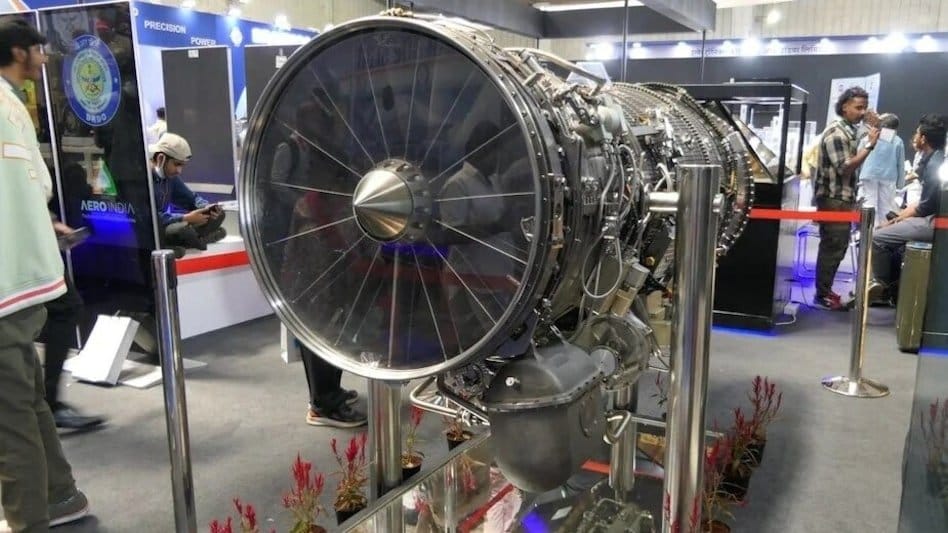

Every serious air force in the world buys its fighters from a short list of makers. A far shorter list can build the engines that fly them. India has spent four decades trying to move from the first list to the second and its long-troubled Kaveri programme is the story of how hard that jump really is. Now the effort has a new target and a new name. According to The Week, engineers are re-designing the Kaveri 2.0 around a new core to produce 90 kilonewtons of thrust, aimed at the mid-life upgrades of the Indian Air Force’s frontline fighters.
The Hardest Thing in Aerospace
To understand why this matters, start with a simple fact. Building a jet engine is arguably the single most difficult thing in all of aerospace engineering, harder in many ways than building the aircraft around it.
The reason lives in the hot section, where air, fuel and fire meet. Turbine blades there must keep their shape while spinning at enormous speed, inside gas hotter than the melting point of the metal they are made from. Getting that right demands mastery of exotic materials and precision manufacturing. It also takes decades of accumulated test data. Only a handful of countries have ever managed it, among them the United States, Russia, France, the United Kingdom and China. India has wanted into that club for a very long time.
A Dream That Kept Stalling
The Kaveri began in the 1980s. The Gas Turbine Research Establishment conceived it to power the Tejas Light Combat Aircraft and free India from foreign engines. It never quite delivered.
The original design struggled with the two things that matter most in a fighter engine: thrust and weight. Reports say the Kaveri could reach only around 41 kilonewtons of dry thrust against the roughly 49 the Tejas needed and it ran heavier than its design goal too. In 2008, after years of missed targets, the programme was effectively frozen. The Tejas Mk1 and Mk1A went on to fly with American engines instead, the GE F404 and its more powerful cousin the F414. That decision quietly defined the next fifteen years of Indian fighter aviation.
The lesson of that period was not that India lacked ambition. It was that a jet engine punishes anything less than complete mastery and India had not yet paid the full price in time, money and failed prototypes that such mastery demands.
Why the Programme Came Back
The revival did not spring from nostalgia. It came from a supply shock.
Deliveries of the GE F404 engines meant for the Tejas Mk1A ran badly late. The holdup stalled a production line. It exposed exactly the vulnerability that indigenous engines exist to remove. When a foreign supplier’s delay can stall your fighter deliveries, the case for building your own stops being about pride. It becomes about basic self-reliance. That shock, more than any technical breakthrough, is what put the Kaveri back on the table.
This time the programme is not starting from a blank sheet. According to reporting, the new effort builds on the dry Kaveri derivative and the hard lessons of the original. It integrates a redesigned core, better compressor and combustion sections and modern digital engine controls.
What Kaveri 2.0 Is Aiming For
The headline number is thrust. The Week reported that Kaveri 2.0 is being re-engineered around a new core to reach 90 kilonewtons, a figure that would place it in the class needed for medium fighters and heavy combat drones. Various reports describe an 80 to 90 kilonewton band, so the exact figure will firm up only as testing proceeds.
The technical wish list, as described in these reports, reads like a catalogue of everything the original Kaveri lacked. Single-crystal turbine blades to survive higher temperatures. Composites and additive manufacturing to cut weight, which reporting suggests has fallen from around 1,235 kilograms toward the 1,100 kilogram range, with a target below 1,000. Full authority digital engine control software to squeeze out performance. Each of these is a genuine engineering challenge in its own right and each was a wall the first Kaveri hit.
The Long Road Still Ahead
A note of realism belongs here. No one is pitching the engine as a straight replacement for the Tejas Mk1A’s powerplant tomorrow. Reports position it instead as a longer-term solution. It targets integration with Tejas variants around 2030 and could eventually power platforms like the Advanced Medium Combat Aircraft and the Ghatak stealth drone.
That timeline is honest about the difficulty. An indigenous fighter engine, if India finally cracks it, would do more than save money. It would insulate the country’s entire combat aviation programme from export controls and supply delays. A foreign engine maker can impose those at the worst possible moment. The original Kaveri failed because the problem was genuinely that hard. Kaveri 2.0 is a bet that four decades of scars have finally taught India enough to clear the wall. The proof, as always with jet engines, will come only on the test bench.