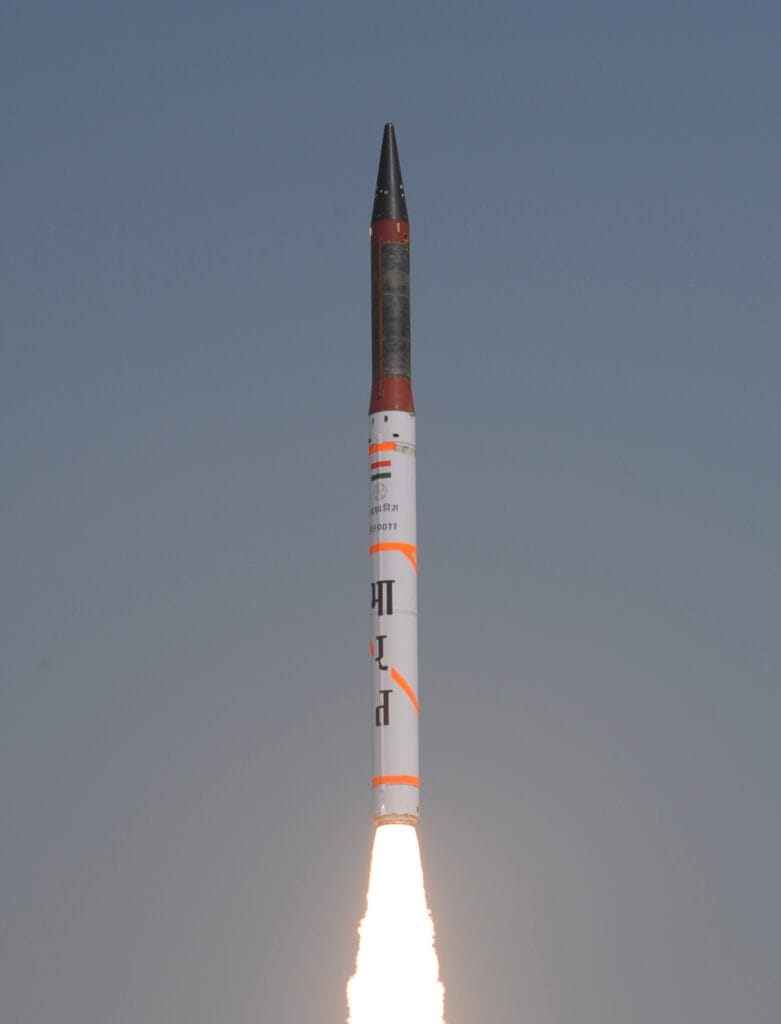

India launched an Agni-4 ballistic missile from the Integrated Test Range at Chandipur off the Odisha coast on 6 August 2026. The Ministry of Defence said the missile flew its full profile and validated every operational and technical parameter set for the exercise. On the surface it reads like routine news. Underneath, the detail that matters is who fired it and why.
A User Trial, Not a Development Test
This was not DRDO putting a new design through its paces. The launch came under the aegis of the Strategic Forces Command, the tri-service body that holds India’s nuclear weapons. That single fact changes what the test was actually measuring.
A developmental test asks whether a missile works. A user trial asks a different question. Can the soldiers who would fire it in a crisis do so, quickly and correctly, with a weapon pulled from the inventory rather than a prototype from the lab? The point is not novelty. It is reliability, crew proficiency and the confidence that the system behaves the same on a bad day as it does on a test range. That is the quieter, harder thing to prove and it is exactly what the Strategic Forces Command was there to confirm.
What the Agni-4 Brings
The Agni-4 sits in the middle of India’s missile family and its numbers explain why it endures. It is a two-stage, solid-fuel missile with a range of around 4,000 kilometres. That reach holds targets deep across the region without stretching to intercontinental distances. It carries a payload of roughly a tonne and stands about 20 metres tall.
Two features give it its edge. The missile is road-mobile, carried and fired from a launcher that moves rather than sits in a fixed silo. It also uses canister-based launch, sealed in a protective tube that keeps it ready and shortens the time from order to lift-off. Together those traits address the oldest problem in nuclear deterrence: survivability. A weapon that can move and launch at short notice is far harder for an adversary to find and destroy before it is used. That is the whole logic behind a credible second-strike force.
Part of a Wider Rhythm
The Agni-4 launch did not happen in isolation. It followed successful trials earlier this year of the Agni-Prime and the longer-ranged Agni-3. All of it forms a steady cadence of tests across India’s land-based deterrent. Read together, these launches are less about any one missile than about the routine itself. A deterrent only works if it is believed. It is only believed if it is exercised in the open, again and again. Reliability has to become the assumption rather than the question.
For a system already inducted into service, the value of another flawless flight is cumulative. Each clean launch adds to the record that a potential adversary must weigh. It also keeps the crews who operate the weapon sharp. The Agni-4 has been in the arsenal for years. The 6 August trial was a reminder. It was aimed less at any single capital than at the general proposition that India’s land-based deterrent is maintained, exercised and ready. In the arithmetic of deterrence, that reminder is the point.