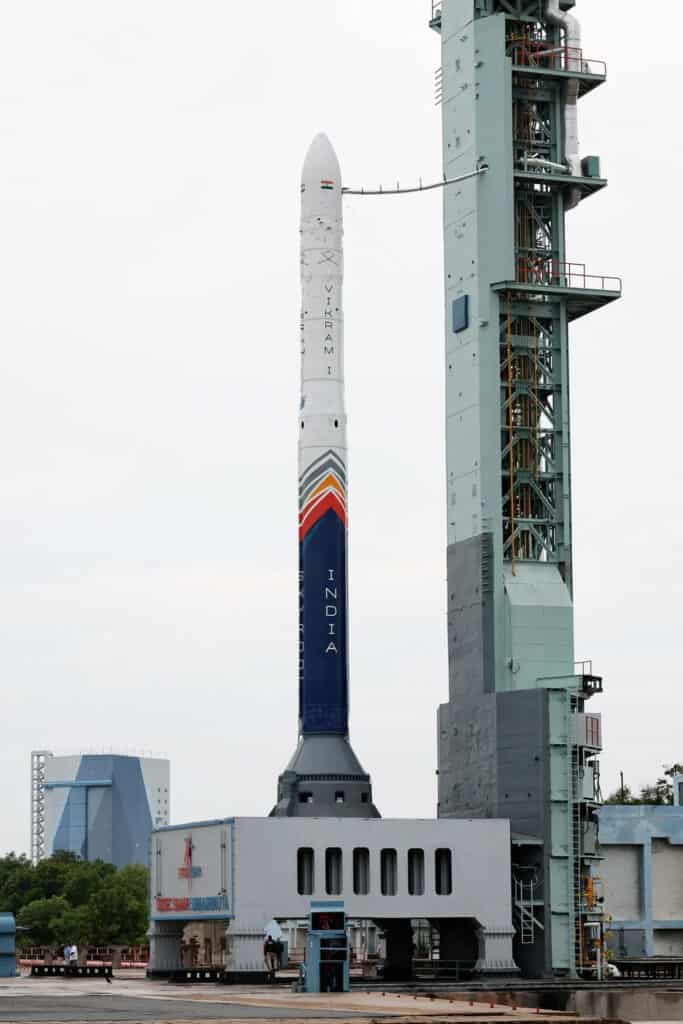

At five minutes past noon on 18 July 2026, a slim carbon-fibre rocket lifted off from Sriharikota. It did something no privately built Indian machine had ever done. It reached orbit. Skyroot Aerospace’s Vikram-1, flying its maiden orbital mission, deployed its payloads into low Earth orbit on the first attempt. With that single flight, India became only the third country on Earth whose private sector can put satellites into space on its own rockets.
The company called the mission Aagaman, the arrival. The name fits. Launches fail on debuts all the time, even for giants. This one did not and it landed, by coincidence or by design, on Skyroot’s eighth birthday.
What Actually Flew
Vikram-1 is a small launch vehicle built for the satellite economy’s fastest-growing segment. It can carry up to 350 kilograms to low Earth orbit and around 260 kilograms to a sun-synchronous orbit, the highway used by most Earth-observation satellites. Its structure is all carbon composite, which keeps it light. Its lower stages burn solid fuel, chosen for reliability, while its upper stage uses a 3D-printed liquid engine for the precise final push into orbit.
The debut flight carried a mixed manifest. The main passenger was SOLARAS, a satellite from Indian startup Grahaa Space. Alongside it rode an in-house technology demonstrator and experiments from Germany’s DCUBED and Cosmoserve Space. The rocket even carried a few cultural artefacts, including a microscopic 18-karat gold rocket honouring India’s space legacy. Every payload reached orbit safely.
One flight does not make a launch business. It does prove the machine, the team and the processes behind it, which is the hardest single step any rocket company ever takes.
Eight Years from Ten People to Orbit
The company behind the rocket started in 2018 with ten people. Two former ISRO engineers, Pawan Kumar Chandana and Naga Bharath Daka, left the security of India’s space agency to build launch vehicles in Hyderabad. Their bet was that the global boom in small satellites would need far more rockets than governments could supply.
For years the bet looked brave rather than smart. Indian law did not even clearly permit private rockets when they began. That changed with the space reforms of 2020, which opened ISRO’s facilities to private firms and created a regulator, IN-SPACe, to oversee them. Skyroot moved fast on the new ground. In November 2022 its suborbital Vikram-S became the first private Indian rocket to reach space, touching the edge of it without entering orbit. The orbital attempt took another four years of engine tests, stage trials and patient engineering.
The money followed the milestones. In May 2026, Skyroot raised 60 million dollars in a round co-led by Singapore’s sovereign wealth fund GIC. The round valued the company at 1.1 billion dollars and made it India’s first space unicorn. Total funding now stands near 150 million dollars across a dozen rounds, with backers ranging from BlackRock-managed funds to the founders of Swiggy. Provisional filings show the company earned around 101 crore rupees in revenue in FY26 and held customer advances of over 252 crore rupees. It projects revenue of more than 13,000 crore rupees by FY32. Those projections deserve healthy scepticism, as all startup projections do. The customer advances are the more telling number. Clients pay in advance only when they believe the rocket will fly.
Why This Launch Matters Beyond Skyroot
The satellite economy has a bottleneck and it is not satellites. Building a small spacecraft has become cheap and fast. Getting it into the right orbit at the right time has not. Small satellite operators today mostly ride as secondary passengers on big rockets, waiting months for a slot and accepting whatever orbit the primary customer chooses. A dedicated small launcher sells exactly what they lack: schedule and orbit on demand. That is the market Vikram-1 enters, against competitors like Rocket Lab in the United States and a crowd of Chinese startups.
For India, the flight carries a second meaning. ISRO remains one of the world’s most capable space agencies, but it is one organisation with one launch calendar. A private launch sector multiplies the country’s access to space without multiplying its space budget. It also feeds a wider industrial base, from carbon-composite manufacturing to 3D-printed engines. This is the same deep-tech muscle India is trying to build in semiconductors and other foundational industries. A country that can make its own chips and launch its own satellites depends on no one for what every modern economy runs on: compute and connectivity.
There is a security dimension too, even if Skyroot itself is a commercial company. Responsive launch, the ability to put a satellite up quickly when needed, is becoming a quiet priority for every serious military. A domestic private launcher gives India options it did not have last month.
The Road Ahead Is Steeper
Now comes the harder part. One successful flight must become a cadence. Skyroot has spoken of scaling toward monthly launches and its order book will only grow if Vikram-1 flies often and on time. Reliability is a statistical property. It is earned over many flights, not declared after one.
Competition will not wait either. Rocket Lab has flown its Electron rocket dozens of times. Chinese small-launch firms are multiplying, backed by deep state support. Skyroot’s answer is already in development: Vikram-II, a larger cryogenic-powered vehicle targeting up to 900 kilograms to low Earth orbit, planned for 2027. Moving from a small solid-fuel rocket to cryogenic engines is a serious jump in difficulty, the kind that has humbled bigger organisations.
Price pressure looms over everything. The small-launch market is crowded and margins are thin, which is why several Western small-launch startups have already folded. Skyroot’s advantage is the same one Indian engineering has always had: capable teams at a fraction of Western cost, now paired with a proven rocket.
The Arrival
Strip away the celebration and one fact remains. A company that did not exist nine years ago has reached orbit on its first attempt. Seven years ago, private rockets were not even legal in India. Vikram-1’s flight does not guarantee what comes next for Skyroot. Markets, cadence and Vikram-II will decide that. What it guarantees is a change in what India’s space industry means. The country is no longer a place where only the government goes to space. Aagaman was the right name. Something new has arrived.